US NEC Chapter 9 planning reference
Confirm the adopted edition and local amendments.
Estimate conduit fill percentage, allowed fill area, and remaining area from conductor area, conductor count, and conduit internal area.
Automatic count-based percentages are limited to the NEC Chapter 9 reference. Other selections use your documented project limit.
Cross-sectional area of one insulated conductor or cable in square inches.
Number of conductors or same-size cables being estimated.
Internal conduit area in square inches from the applicable table.
Optional second conductor or cable area in square inches for mixed-size pulls.
Optional count for the second conductor or cable area.
Percentage used for non-NEC reference profiles. Enter the value from the applicable standard, specification, manufacturer, or authority.
Use 60% fill for short nipples when applicable and verified by code.
Length in inches. The NEC-style 60% exception is only considered for a qualifying nipple not over 24 inches (600 mm).
Status: initial
The selected conductor groups are compared with a 40% planning limit, leaving 0.04 in² of allowed area.
US NEC Chapter 9 planning reference
Confirm the adopted edition and local amendments.
Calculate to select the applicable fill-limit method.
40% is used for this result.
Verify the adopted electrical standard, raceway and conductor tables, local amendments, and installation approval.
A passing area comparison is not installation approval.
Verify conductor insulation area, raceway table values, nipple eligibility, derating, and local code amendments before installation.
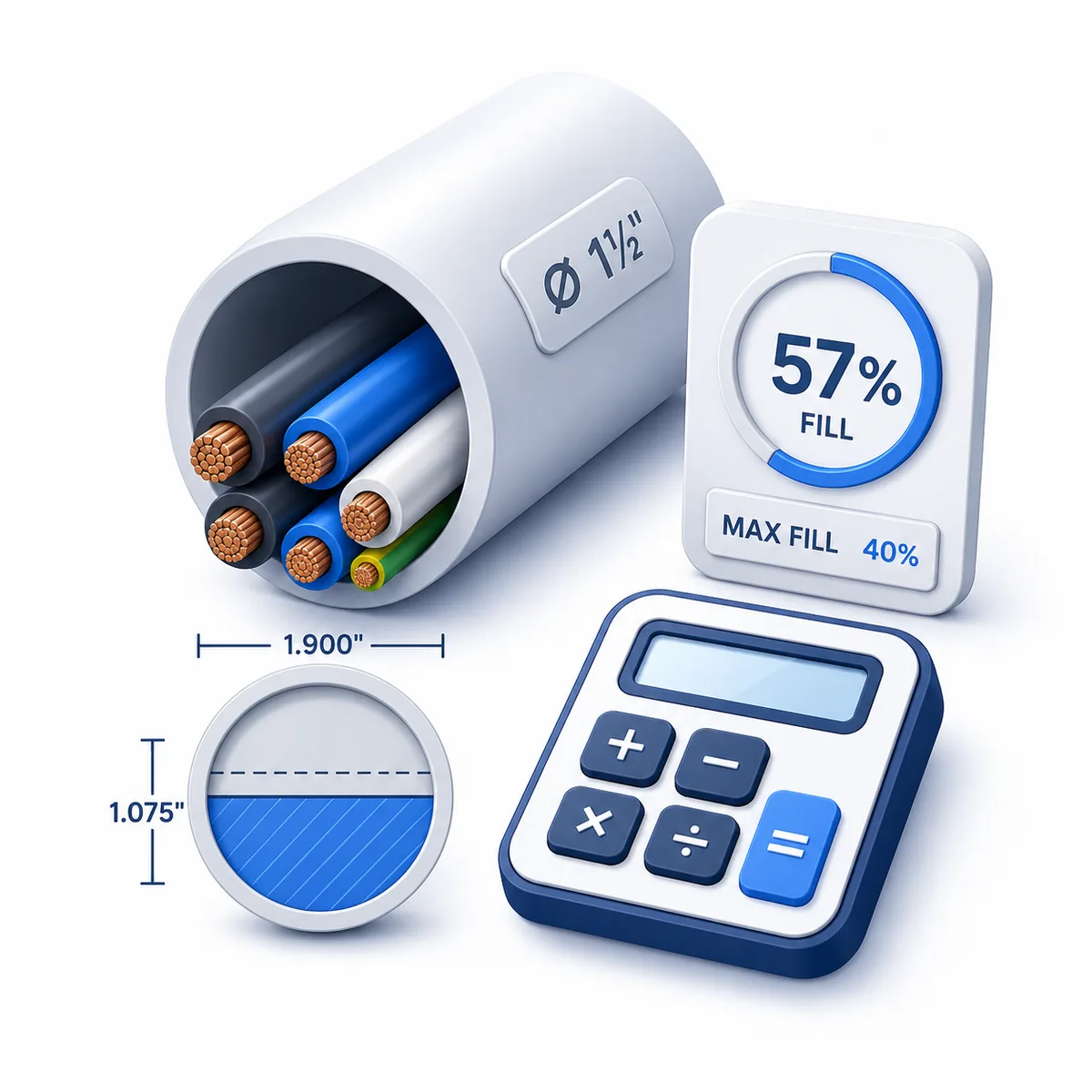
The Conduit Fill Calculator estimates how much of a conduit interior is occupied by entered conductor areas and conductor counts. Select an NEC Chapter 9 reference or enter a documented regional project limit, and optionally add a second group for mixed-size pulls.
Conduit fill is the percentage of a raceway's internal cross-sectional area occupied by conductors or cables.
Conduit fill percentage equals the sum of conductor group areas divided by conduit internal area, multiplied by 100. The NEC reference uses 53% for one conductor, 31% for two, and 40% for over two; other profiles use the documented project limit you enter.
Understand what each input and result means before calculating.
Area of one insulated conductor or cable in square inches.
Number of conductors or same-size cables.
Optional second conductor area and count for mixed-size conduit fill estimates.
Internal conduit area from the applicable table.
Planning limit used for the entered conductor count.
Allowed area minus total conductor area.
Formula behavior, validation cases, explanatory examples, and cited sources are checked before publication. This review supports educational accuracy and is not a substitute for qualified professional advice.
Last reviewed: 2026-08-25
See the calculation logic, variable definitions, and practical meaning.
Total Area = sum of each conductor area x count
Use table values or measured cross-sectional areas.
Fill % = total conductor area / conduit area x 100
This estimates how much of the internal conduit area is occupied.
Allowed Area = conduit area x allowed fill %
Compare total conductor area with the allowed area.
Max conductors = floor(allowed area / primary conductor area)
This gives a rough same-size capacity check before other code, derating, and pulling conditions are reviewed.
Follow realistic inputs through the calculation step by step.
Worked example
Worked example
Worked example
Worked example
Avoid these common input and interpretation errors.
Conduit fill uses insulated conductor or cable area, not bare copper size.
Internal area varies by raceway type, trade size, and table.
One and two conductor cases use different fill limits, and short nipples may have separate rules.
Final work should be checked against current code, local amendments, and qualified review.
Mixed conductor sizes should be summed by group instead of multiplying one area by the full count.
Fill percentage is only one check. Pull length, bends, jamming, and ampacity derating may still matter.
Quick answers to the questions users ask most often.
Sources used to support the calculator guidance.
Continue with calculators that solve nearby problems.
A transparent record of calculator content updates.
Added a result-aware fill-limit summary and grouped mixed-conductor and short-nipple controls under advanced options.
Initial conduit fill calculator release.
Added mixed conductor group support, max same-size conductor estimate, fill limit reference, and planning checklist.