Cubic Feet Calculator
Calculate cubic feet, cubic metres, litres, and other volume conversions from matching or mixed measurement units.
- cubic foot
- cubic footage
- volume calculator
- box volume
- shipping cube
Enter the rectangular length.
Enter the rectangular width.
Enter the height, depth, or thickness.
Use one unit for every dimension or choose each unit separately.
Choose the unit used for all three dimensions.
Optional number of identical boxes, spaces, or items.
Optional extra percentage for compaction, packing gaps, spills, or ordering margin.
Optional bag or container size in cubic feet for bag-count estimates.
Optional material density in pounds per cubic foot for rough weight estimates.
Optional price for a rough cost estimate.
Status: initial
Results
Awaiting calculation
Turn three measurements into usable cubic footage
Each dimension is normalized once, then the same volume is shown prominently in both imperial and metric units.
Measure before ordering
- 1Measure length, width, and height or depth at their widest relevant points.
- 2Choose mixed units when one measurement uses inches and another uses feet or metric units.
- 3Compare ft³, m³, and litres before matching the result to a supplier or container size.
Use inside dimensions for container capacity and outside dimensions for shipping size.
Introduction
The Cubic Feet Calculator finds the volume of a rectangular box, room, shipment, container, or material area from length, width, and height.
What is a cubic foot?
A cubic foot is a unit of volume equal to a cube that is 1 foot long, 1 foot wide, and 1 foot high. Cubic feet are commonly used for rooms, boxes, containers, appliances, shipping, mulch, soil, gravel, and storage capacity.
Cubic feet formula
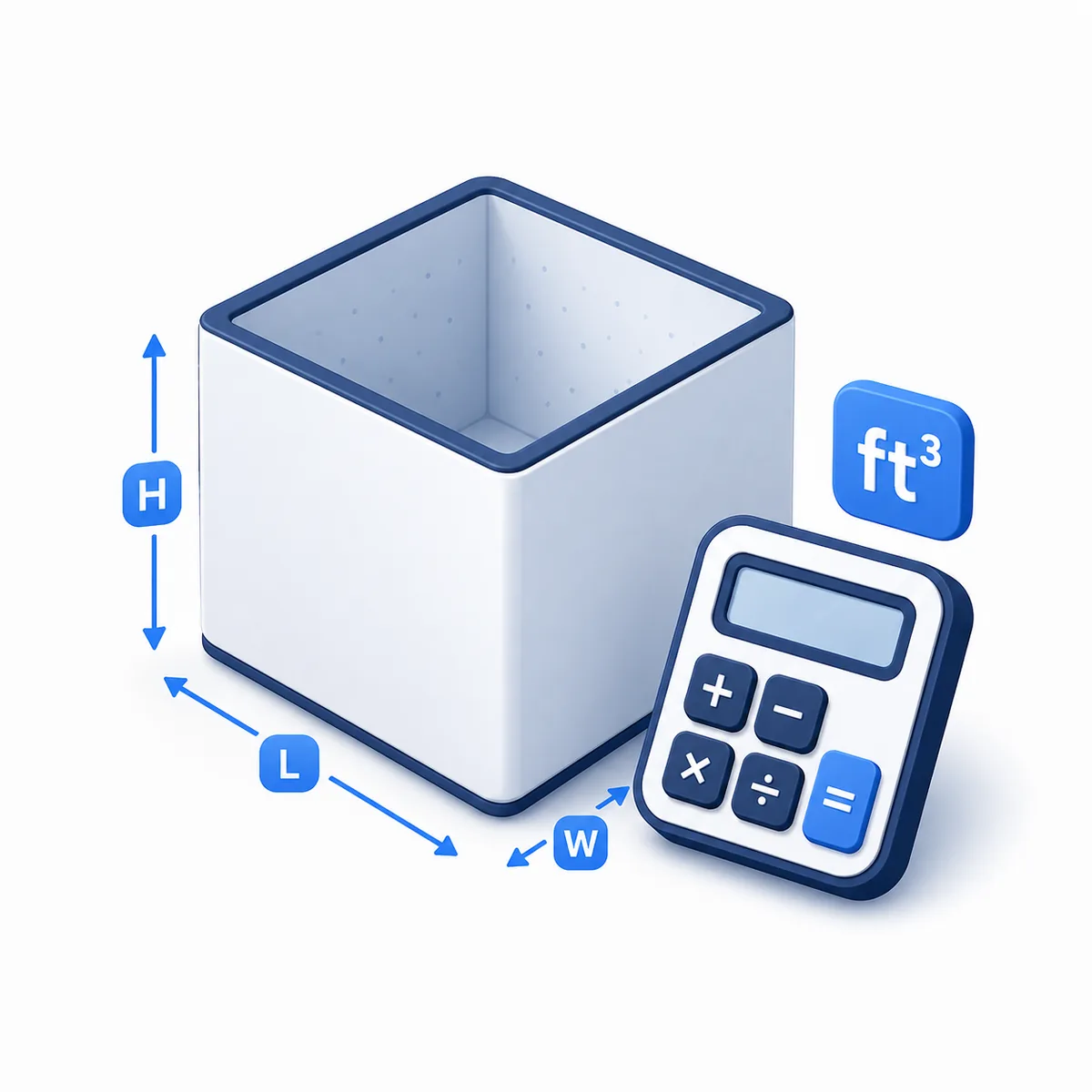
For a rectangular shape, cubic feet equals length in feet multiplied by width in feet multiplied by height in feet. Each dimension can use the same unit or its own unit; the calculator converts every measurement to feet before multiplying.
Variable explanations
Understand what each input and result means before calculating.
Length
The longest side or front-to-back measurement.
Width
The side-to-side measurement.
Height or depth
The vertical, depth, or thickness measurement.
Measurement units
Use one shared unit or select separate units for length, width, and height.
Quantity
The number of identical boxes, spaces, or items.
Waste or overage
Optional percentage added for compaction, gaps, or margin.
Bag size
Optional bag or container volume in cubic feet for whole-bag estimates.
Density
Optional pounds per cubic foot used for rough weight and ton estimates.
Reviewed by the Calculator.org.in Editorial Team
Formula behavior, validation cases, explanatory examples, and cited sources are checked before publication. This review supports educational accuracy and is not a substitute for qualified professional advice.
Last reviewed: 2026-08-25
Formula guide
See the calculation logic, variable definitions, and practical meaning.
Mixed measurement units
Cubic Feet = Length(ft) x Width(ft) x Height(ft)
- Each entered dimension is converted independently, such as feet for length and inches for depth.
Independent conversion avoids manually turning a thin depth in inches into a decimal number of feet.
Cubic feet
Cubic Feet = Length(ft) x Width(ft) x Height(ft)
- Length, width, and height must use feet before multiplying.
This is the standard rectangular volume formula.
Cubic yards
Cubic Yards = Cubic Feet / 27
- One cubic yard equals 27 cubic feet.
This is useful for bulk materials such as soil, mulch, gravel, or concrete.
Cubic inches
Cubic Inches = Cubic Feet x 1,728
- One cubic foot equals 1,728 cubic inches.
This helps compare measurements entered or reported in inches.
Liters and gallons
Liters = ft^3 x 28.3168; US gallons = ft^3 x 7.4805
- These conversions are useful for containers and liquid capacity.
Volume can be converted into common liquid-capacity units.
Waste-adjusted volume
Adjusted Volume = cubic feet x (1 + waste %)
- Waste accounts for compaction, gaps, or ordering margin.
This helps with real-world material estimating.
Estimated weight
Weight = adjusted cubic feet x density
- Density is entered in pounds per cubic foot.
This is a rough estimate because material density changes with moisture and compaction.
Worked examples
Follow realistic inputs through the calculation step by step.
Worked example
Room volume
- 1Length is 10 ft.
- 2Width is 8 ft.
- 3Height is 9 ft.
- 4Volume is 720 cubic feet.
Worked example
Box in inches
- 1Enter 30 x 36 x 25 inches.
- 2Each dimension is converted to feet.
- 3Volume is 15.63 cubic feet.
Worked example
Material depth
- 1Enter length and width.
- 2Use height as depth or thickness.
- 3Convert total cubic feet to cubic yards.
Worked example
Bagged mulch or soil
- 1Enter area dimensions and depth.
- 2Add a waste or compaction allowance.
- 3Enter bag size in cubic feet.
- 4Review bags or containers needed.
Worked example
Container capacity
- 1Use inside dimensions for length, width, and height.
- 2Review cubic feet, liters, and US gallons.
- 3Use the conversion table to compare storage or liquid capacity.
Common mistakes
Avoid these common input and interpretation errors.
Mixing units
Do not treat inches as feet. Choose mixed units when the dimensions are not measured in the same unit.
Using exterior dimensions
For capacity, measure the inside dimensions of the container or space.
Ignoring waste
Materials may need extra allowance for compaction, cutting, or uneven surfaces.
Using cubic feet for irregular shapes
Irregular shapes may need a different formula or a specialized calculator.
Forgetting supplier units
Bulk material may be sold by cubic yard, bag, ton, or truckload rather than cubic foot.
Treating density as fixed
Material weight changes with moisture, compaction, and material mix.
Frequently asked questions
Quick answers to the questions users ask most often.
What does this Cubic Feet Calculator calculate?
How do you calculate cubic feet?
What is the cubic feet formula?
How many cubic feet are in a cubic yard?
How many cubic inches are in a cubic foot?
Can I enter inches?
Can I enter meters or centimeters?
Can I mix feet and inches in one calculation?
How do I calculate cubic feet when depth is in inches?
Can I calculate multiple boxes?
Does this calculate weight?
Does this calculate cylinder volume?
Can I use this for mulch or soil?
Can I use this for shipping?
Should I measure inside or outside dimensions?
Why does the calculator show cubic yards?
Is this an exact material order?
How many gallons are in a cubic foot?
How many liters are in a cubic foot?
Can this estimate bags of mulch or soil?
Can this estimate weight?
References
Sources used to support the calculator guidance.
Related calculators
Continue with calculators that solve nearby problems.
Version history
A transparent record of calculator content updates.
- 1.2.0 · 2026-08-25
Added mixed units for length, width, and height, refreshed search metadata, and clarified weight guidance.
- 1.0.0 · 2026-07-05
Initial cubic feet calculator release.
- 1.1.0 · 2026-08-02
Added waste-adjusted volume, bag estimates, density-based weight estimates, gallons, liters, cubic meters, conversion table, and planning checklist.