Cubic Yard Calculator
Estimate cubic yards or cubic metres, waste allowance, rounded orders, bags, tonnage, and optional material cost using imperial or metric inputs.
- cubic yards
- yardage
- mulch calculator
- soil calculator
- gravel calculator
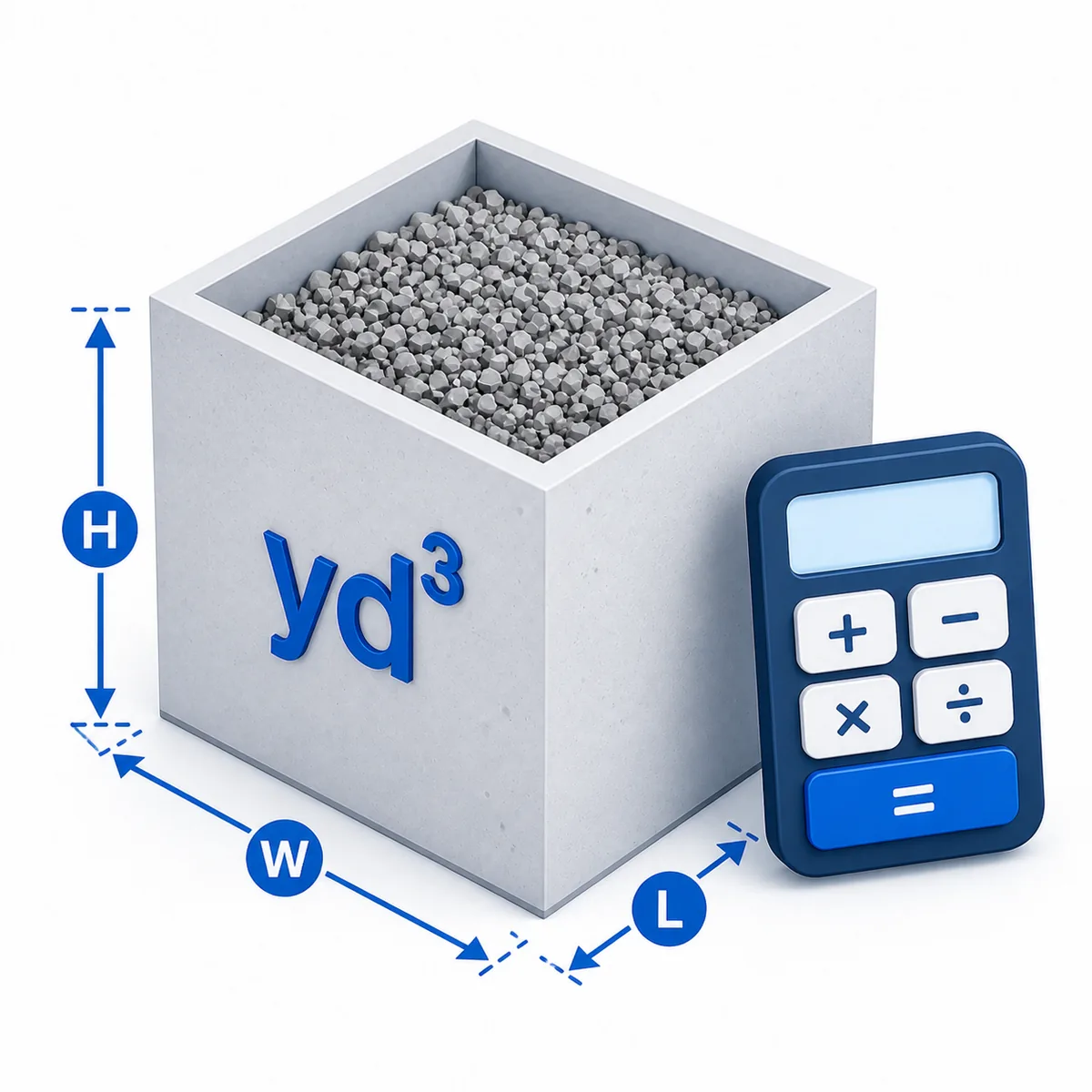
Use feet and inches, or metres and centimetres, throughout the calculation.
Enter feet in imperial mode or metres in metric mode.
Enter feet in imperial mode or metres in metric mode.
Enter inches in imperial mode or centimetres in metric mode.
Optional extra percentage for compaction, grading, and supplier rounding.
Advanced optionsOptional issuer and comparison assumptions
Enter cubic feet in imperial mode or litres in metric mode.
Enter tons per cubic yard in imperial mode or tons per cubic metre in metric mode.
Round cubic yards in imperial mode or cubic metres in metric mode.
Enter price per cubic yard in imperial mode or per cubic metre in metric mode.
Status: initial
Results
Awaiting calculation
Order about 4 yd³
The rounded supplier quantity equals about 4 yd³ or 3.1 m³.
Turn measurements into an order
- 1Choose imperial or metric, then measure the matching shape and material depth.
- 2Add waste for grading, compaction, settlement, and uneven excavation where appropriate.
- 3Open advanced options only when you need bags, tons, supplier rounding, or cost.
Bulk-material density, moisture, compaction, minimum orders, and bag yield vary by supplier and product; confirm them before purchase.
Introduction
The Cubic Yard Calculator estimates bulk material volume from area dimensions and depth. It is useful for planning mulch, topsoil, gravel, sand, compost, fill, and similar landscaping or construction materials.
Purpose
Use this calculator to turn simple field measurements into cubic feet, cubic yards, order quantity with waste, rounded supplier order quantity, bag count, rough tonnage, and optional material cost before requesting a quote.
How cubic yards are calculated
The calculator finds the surface area, converts depth from inches to feet, multiplies area by depth to get cubic feet, then divides by 27 because one cubic yard equals 27 cubic feet.
Variable explanations
Understand what each input and result means before calculating.
Shape
The basic area shape used to calculate square footage.
Length
The long side of a rectangular or triangular area in feet.
Width
The short side of a rectangular or triangular area in feet.
Diameter
The full width across a circular area in feet.
Depth
The material thickness in inches, such as 2 inches of mulch or 4 inches of gravel.
Waste allowance
Extra volume added for grading variation, compaction, spillage, and delivery rounding.
Price per cubic yard
Optional supplier price used only for a rough material cost estimate.
Bag size
Optional bag size in cubic feet for bagged material estimates.
Density
Optional tons per cubic yard used for rough tonnage estimates.
Order rounding
Supplier-style rounding increment for practical order planning.
Reviewed by the Calculator.org.in Editorial Team
Formula behavior, validation cases, explanatory examples, and cited sources are checked before publication. This review supports educational accuracy and is not a substitute for qualified professional advice.
Last reviewed: 2026-08-02
Formula guide
See the calculation logic, variable definitions, and practical meaning.
Rectangle or square
Cubic yards = length x width x depth(feet) / 27
- Length and width are in feet.
- Depth is converted from inches to feet.
Use this for beds, slabs, trenches, rectangular pads, and most straight-sided areas.
Triangle
Cubic yards = length x width x depth(feet) / 2 / 27
- Length and width describe the triangular area.
- Depth is material depth.
Use this for corner beds or triangular sections.
Circle
Cubic yards = pi x radius^2 x depth(feet) / 27
- Radius is half the diameter.
- Depth is converted from inches to feet.
Use this for circular beds, round pads, fire pit areas, or tree rings.
Coverage per cubic yard
Coverage at depth = 324 / depth in inches
- One cubic yard covers 324 square feet at 1 inch deep.
This helps compare common mulch, soil, gravel, and compost depths.
Tons
Tons = cubic yards with waste x tons per cubic yard
- Density depends on material, moisture, and compaction.
Use this only as a rough weight estimate when a supplier gives density.
Bags
Bags = cubic feet with waste / bag size
- Bag size is entered in cubic feet.
The calculator rounds up because bags are purchased as whole units.
Worked examples
Follow realistic inputs through the calculation step by step.
Worked example
Mulch bed
- 1Enter a 20 ft length and 8 ft width.
- 2Set depth to 3 inches.
- 3Add a small waste allowance and review cubic yards to order.
Worked example
Gravel path
- 1Measure the path as one or more rectangular sections.
- 2Enter depth based on the planned gravel layer.
- 3Use cubic yards with waste for supplier conversations.
Worked example
Circular planting bed
- 1Choose circle as the shape.
- 2Enter the bed diameter in feet.
- 3Enter mulch or soil depth in inches.
Worked example
Budget estimate
- 1Enter price per cubic yard from a supplier quote.
- 2Calculate volume with waste.
- 3Use estimated cost as planning context, not a final invoice.
Worked example
Bagged material estimate
- 1Enter the area and depth.
- 2Add waste or overage.
- 3Enter bag size in cubic feet.
- 4Review bags needed and bags-per-yard conversion.
Worked example
Tonnage estimate
- 1Ask the supplier for tons per cubic yard.
- 2Enter that density.
- 3Review estimated tons in the order summary.
Common mistakes
Avoid these common input and interpretation errors.
Mixing depth units
Depth is entered in inches and converted to feet before calculating volume.
Forgetting that one yard is 27 cubic feet
Cubic feet are divided by 27 to convert to cubic yards.
Ordering without waste
Bulk materials can settle, compact, spill, or be rounded by delivery rules.
Using one rectangle for an irregular area
Break irregular spaces into smaller rectangles, triangles, or circles and add the results.
Confusing bags and yards
A cubic yard is 27 cubic feet, so bag count depends heavily on bag size.
Using a generic tons conversion
Tons per cubic yard can vary widely by material and moisture.
Frequently asked questions
Quick answers to the questions users ask most often.
What does this Cubic Yard Calculator calculate?
What is the formula for cubic yards?
Why do you divide by 27?
Can I enter depth in inches?
Can this calculate mulch?
Can this calculate gravel?
Can this calculate topsoil?
Can this calculate concrete?
What waste allowance should I use?
Does this convert cubic yards to tons?
How do I calculate an irregular area?
Should I round up cubic yards?
Is the cost estimate final?
What does one cubic yard look like?
Is this engineering advice?
How many bags are in one cubic yard?
How much area does one cubic yard cover?
Why round the order quantity?
References
Sources used to support the calculator guidance.
Related calculators
Continue with calculators that solve nearby problems.
Version history
A transparent record of calculator content updates.
- 1.0.0 · 2026-07-05
Initial cubic yard calculator release.
- 1.1.0 · 2026-08-02
Added rounded order quantity, bag counts, tonnage, coverage per yard, depth comparison, bag conversion, and ordering checklist.