Gematria Calculator
Calculate and compare English, Hebrew, and Jewish/Latin gematria values with word totals, letter breakdowns, and transparent input handling.
- english ordinal
- reverse ordinal
- english reduction
- reverse reduction
- sumerian gematria
Enter up to 300 characters. English A-Z and Hebrew letters are counted; other characters are ignored.
Enter a second word or phrase to compare totals under the same English and Hebrew ciphers.
Status: initial
Results
Awaiting calculation
One spelling, several clearly named values
Follow the entered letters through ordinal, reduction, reverse, Jewish/Latin, Sumerian, and Hebrew tables.
Read the totals consistently
- 1Check the recognized-text row for the exact letters that were scored.
- 2Compare phrases only within the same named cipher and spelling.
- 3Use the letter table to verify every addition behind the total.
A matching total is an arithmetic match under one named cipher, not evidence of a hidden relationship.
Introduction
The Gematria Calculator converts words and phrases into numeric totals using common English, Jewish/Latin, and Hebrew letter-value systems. It shows multiple cipher totals together, compares two phrases, and provides word-level, letter-level, and ignored-character details.
What is gematria?
Gematria is a text-to-number practice where letters are assigned values and added together. This calculator focuses on transparent arithmetic so users can see exactly which letters were counted and how each total was produced.
Gematria method
The calculator counts English A-Z and Hebrew letters, reports ignored punctuation and numbers, assigns each recognized letter a value for every supported cipher, and sums those values. Phrase comparisons use the same spelling and named cipher on both sides.
Variable explanations
Understand what each input and result means before calculating.
Phrase
The word, name, or sentence entered by the user.
Letters counted
English A-Z and Hebrew letters included in the totals.
English ordinal
Alphabet-position values from 1 to 26.
Reverse
Reverse alphabet-position values from 26 to 1.
Reduction
Repeating English values from 1 to 9.
Sumerian
English ordinal values multiplied by 6.
Jewish / Latin
An Agrippa-style Latin-letter mapping with values from 1 through 800.
Hebrew standard
Hebrew letters valued from Aleph=1 through Tav=400.
Word breakdown
Per-word totals for phrases with multiple words.
Reviewed by the Calculator.org.in Editorial Team
Formula behavior, validation cases, explanatory examples, and cited sources are checked before publication. This review supports educational accuracy and is not a substitute for qualified professional advice.
Last reviewed: 2026-08-25
Formula guide
See the calculation logic, variable definitions, and practical meaning.
English ordinal
A = 1, B = 2, ... Z = 26
- Each English letter uses its alphabet position.
This is often called simple or ordinal English gematria.
Reverse ordinal
A = 26, B = 25, ... Z = 1
- Alphabet positions are reversed.
This mirrors the ordinal system from the opposite end of the alphabet.
Reduction
A-I = 1-9, J-R = 1-9, S-Z = 1-8
- Letter values repeat from 1 to 9.
This is a compact form sometimes called full reduction or Pythagorean reduction.
English sumerian
Sumerian = English ordinal x 6
- A=6, B=12, ... Z=156.
This is a modern English reference cipher used by many gematria tools.
English primes
A=2, B=3, C=5, ... Z=101
- Each English letter receives the matching prime-number sequence value.
This provides a non-linear comparison cipher.
Jewish / Latin
A-I = 1-9, J-R = 10-90, S-Z = 100-800
- The value scale changes by place-value groups across the Latin alphabet.
This Agrippa-style English/Latin mapping is often labeled Jewish Gematria by modern calculators; it is not the same as scoring Hebrew letters.
Hebrew standard
Aleph=1 through Tav=400
- Final forms are counted as their base letter in the standard total.
This follows the common Hebrew standard-value approach.
Hebrew final forms
Final Kaf=500, final Mem=600, final Nun=700, final Pe=800, final Tsadi=900
- Only final-form letters receive the larger values.
This gives a separate final-form total for Hebrew text.
Worked examples
Follow realistic inputs through the calculation step by step.
Worked example
English ordinal example
- 1HELLO uses H=8, E=5, L=12, L=12, O=15.
- 2The ordinal total is 52.
Worked example
Reverse ordinal example
- 1HELLO uses H=19, E=22, L=15, L=15, O=12.
- 2The reverse total is 83.
Worked example
Reduction example
- 1HELLO uses H=8, E=5, L=3, L=3, O=6.
- 2The reduction total is 25.
Worked example
Hebrew standard example
- 1The Hebrew word חי uses Chet=8 and Yod=10.
- 2The Hebrew standard total is 18.
Worked example
Phrase breakdown
- 1Enter a phrase with multiple words.
- 2Review the total across the phrase.
- 3Use the word breakdown table to see each word separately.
Worked example
Compare two phrases
- 1Enter the first phrase and an optional comparison phrase.
- 2Calculate both with the same spelling rules and cipher tables.
- 3Review Match, Different, or No letters scored for each named cipher.
Common mistakes
Avoid these common input and interpretation errors.
Expecting all calculators to match
Different sites may include different ciphers, alphabets, final-letter handling, or matching databases.
Counting punctuation
This calculator ignores spaces, numbers, punctuation, marks, and symbols.
Mixing English and Hebrew systems
English ciphers and Hebrew ciphers use different alphabets, so their totals should be interpreted separately.
Confusing ordinal and sumerian
English sumerian values are English ordinal values multiplied by 6.
Missing Hebrew final forms
Hebrew standard treats final letters as their base forms, while the final-form output gives them larger values.
Treating totals as proof
Equal totals are arithmetic matches and should not be treated as verified meanings.
Expecting Greek or date numerology
This page supports English and Hebrew text ciphers, not Greek isopsephy or date calculators.
Treating an equal total as proof of a relationship
A matching total only confirms that two entered spellings sum to the same number under one named cipher.
Frequently asked questions
Quick answers to the questions users ask most often.
What does this Gematria Calculator calculate?
What characters are counted?
Is capitalization important?
What is English ordinal gematria?
What is reverse ordinal gematria?
What is English reduction?
What is reverse reduction?
What is English sumerian gematria?
What is reverse sumerian?
What is English primes gematria?
What is Jewish or Latin gematria on this calculator?
Does this support Hebrew gematria?
Does this support Hebrew vowel marks?
Does this support Greek isopsephy?
Why do other calculators show different values?
Can I see the letter-by-letter math?
Can I see word-by-word totals?
Can I compare two words or phrases?
Can I see which characters were ignored?
Is gematria a scientific method?
Can I use full sentences?
What is the character limit?
Can this decode hidden messages?
Does this search for matching phrases?
References
Sources used to support the calculator guidance.
Related calculators
Continue with calculators that solve nearby problems.
Version history
A transparent record of calculator content updates.
- 1.0.0 · 2026-07-05
Initial gematria calculator release.
- 1.1.0 · 2026-08-03
Added Hebrew standard/ordinal/final-form totals, additional English ciphers, word breakdown, digital root, and cipher reference outputs.
- 1.2.0 · 2026-08-25
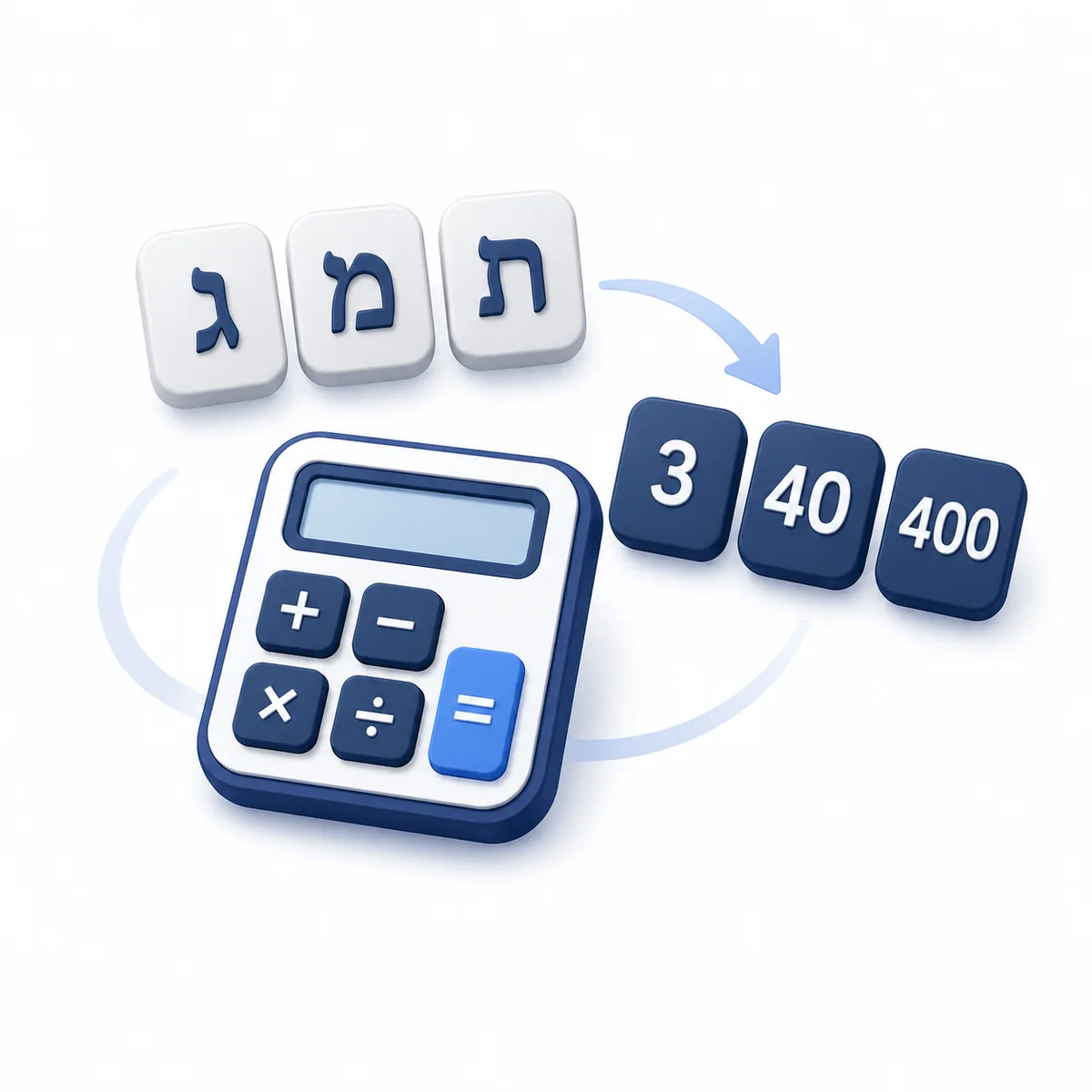
Added Jewish/Latin values, optional two-phrase comparison, ignored-character auditing, a page-specific cipher visual, and refreshed search metadata.