Rounding Calculator
Round numbers by decimal places, significant figures, place value, custom multiple, ceiling, floor, or truncation with tie-rule and comparison outputs.
- round numbers
- decimal places
- significant figures
- nearest tenth
- nearest hundredth
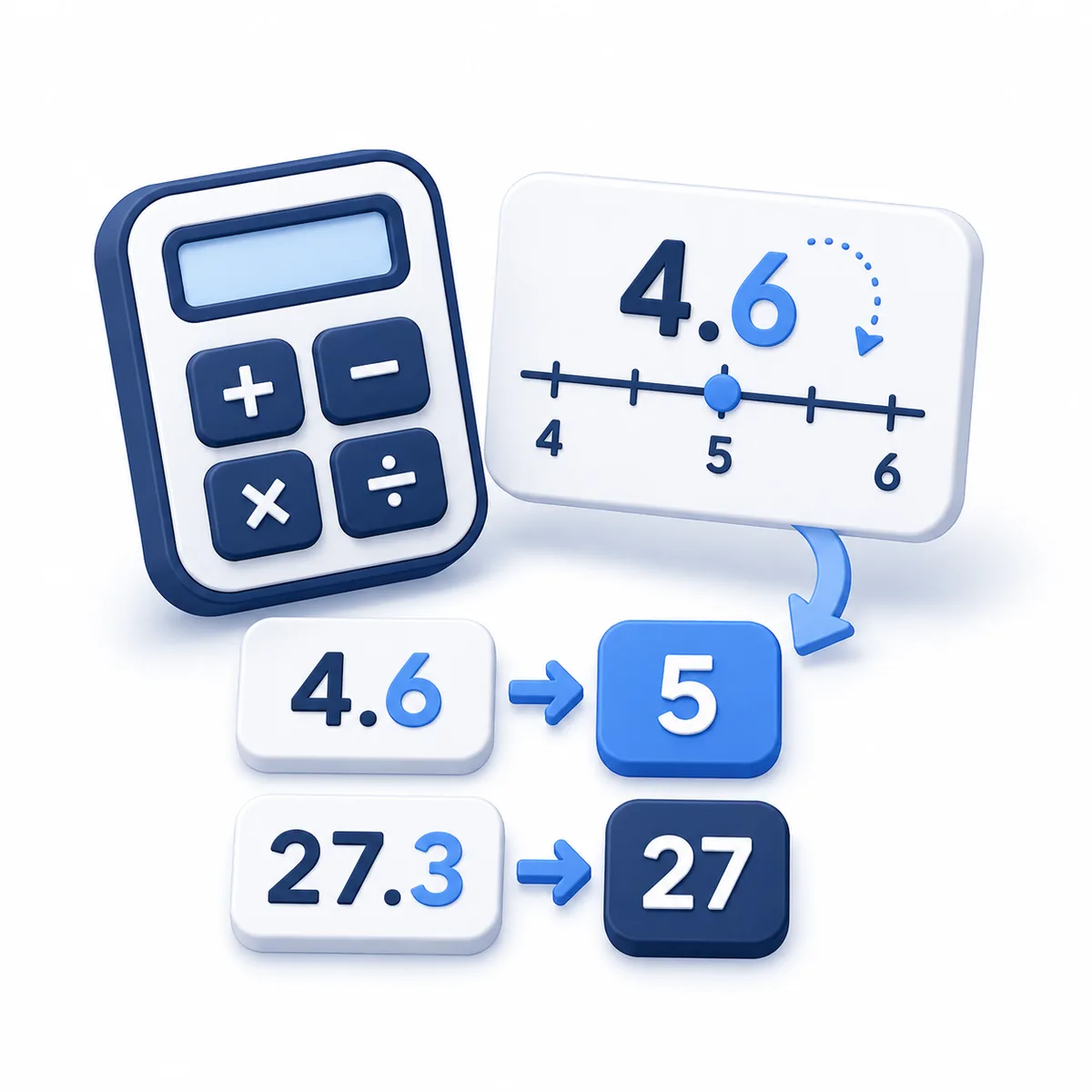
Enter the integer or decimal number to round.
Choose how the number should be rounded.
Digits to keep after the decimal point.
Choose how exact 5 ties should be handled.
Status: initial
Results
Awaiting calculation
15.496 rounds to 15.50
The absolute change is 0.004. The selected tie rule matters only when the discarded portion is exactly halfway between two choices.
Apply the right rounding method
- 1Choose decimal places for digits after the decimal, or significant figures for meaningful digits overall.
- 2Use place value or nearest multiple for cash, packaging, measurements, and practical increments.
- 3Check the exact-5 rule when matching financial, scientific, or software conventions.
Keep extra precision during intermediate calculations and round the final result once to reduce accumulated error.
Introduction
The Rounding Calculator rounds numbers by decimal places, significant figures, nearest place value, custom multiple, ceiling, floor, or truncation. It also shows a decision table, common rounding comparisons, scientific notation, and the difference from the original number.
What is rounding?
Rounding replaces a number with a nearby value that is shorter or easier to use while preserving the level of precision needed for a class, report, estimate, measurement, or calculation.
How this rounding calculator works
Choose the rounding mode, target precision, and exact-5 tie rule. The calculator applies the selected rule, shows the rounded result, and compares it with common targets such as nearest whole number, tenth, hundredth, significant figures, ceiling, floor, and truncation.
Variable explanations
Understand what each input and result means before calculating.
Number
The original value to round.
Rounding mode
The selected method: decimals, significant figures, place value, ceiling, floor, or truncate.
Decimal places
Digits kept after the decimal point.
Significant figures
Meaningful digits kept from the number.
Place value
Nearest unit, ten, tenth, or other selected place.
Nearest multiple
A custom step such as 0.05, 0.25, 5, or 25.
Rounding rule
How exact 5 ties are handled.
Difference
Rounded result minus the original number.
Scientific notation
A compact power-of-ten representation of the rounded result.
Reviewed by the Calculator.org.in Editorial Team
Formula behavior, validation cases, explanatory examples, and cited sources are checked before publication. This review supports educational accuracy and is not a substitute for qualified professional advice.
Last reviewed: 2026-08-25
Formula guide
See the calculation logic, variable definitions, and practical meaning.
Decimal places
Rounded = round(number x 10^places) / 10^places
- Decimal places are digits to the right of the decimal point.
Use this for money-style, measurement-style, or fixed decimal precision.
Significant figures
Keep the selected number of meaningful digits
- Leading zeros are not significant.
- Zeros after a decimal can be significant.
Use this when scientific or measurement precision matters.
Place value
Rounded = round(number / place value) x place value
- Place value can be tens, hundreds, tenths, hundredths, and more.
Use this to round to nearest ten, hundred, tenth, or another supported place.
Nearest multiple
Rounded = round(number / multiple) x multiple
- The multiple must be greater than zero, such as 0.05, 0.25, 5, or 25.
Use this for cash increments, package quantities, time blocks, or custom steps.
Ceiling
Ceiling = next greater whole number
- For negative values, ceiling moves toward zero.
Use this when you always need to round upward on the number line.
Floor
Floor = next lower whole number
- For negative values, floor moves away from zero.
Use this when you always need to round downward on the number line.
Truncate
Truncate = remove decimal part toward zero
- The discarded digits do not affect the result.
Use this when you need to cut off decimals without rounding.
Tie rule
Exact 5 can round away from zero or to the nearest even digit
- Tie rules matter only when the discarded part is exactly half.
This explains why some calculators, spreadsheets, and programming languages disagree.
Worked examples
Follow realistic inputs through the calculation step by step.
Worked example
Decimal places
- 115.496 rounded to 2 decimal places is 15.50.
- 2The third decimal digit is 6, so the hundredths digit increases.
Worked example
Nearest tenth
- 115.496 rounded to the nearest tenth is 15.5.
- 2The hundredths digit is 9, so the tenths digit increases.
Worked example
Significant figures
- 10.012345 rounded to 3 significant figures is 0.0123.
- 2Leading zeros are not counted as significant.
Worked example
Nearest ten
- 1246 rounded to the nearest ten is 250.
- 2The ones digit is 6, so the tens digit increases.
Worked example
Nearest multiple
- 17.30 rounded to the nearest 0.25 is 7.25.
- 2Divide 7.30 by 0.25, round the quotient, then multiply by 0.25.
Worked example
Exact 5 tie
- 12.5 rounds to 3 with the away-from-zero rule.
- 22.5 rounds to 2 with the round-to-even rule.
- 3Choose the rule your class, spreadsheet, or policy expects.
Common mistakes
Avoid these common input and interpretation errors.
Confusing decimal places and significant figures
Decimal places count digits after the decimal. Significant figures count meaningful digits from the first non-zero digit.
Using truncation as rounding
Truncation removes digits toward zero and does not look at the next digit.
Ignoring exact-5 tie rules
Half-away-from-zero and half-to-even can produce different answers for values like 2.5, 12.25, or -2.5.
Expecting every software tool to match
Some systems use banker's rounding, decimal rounding, or binary floating-point behavior.
Rounding too early
For multi-step calculations, round final results unless the workflow requires earlier rounding.
Misreading negative ceiling and floor
For negative numbers, ceiling moves toward zero while floor moves farther negative.
Hiding significant trailing zeros
A result like 15.50 communicates two decimal places, while 15.5 may communicate less fixed precision.
Frequently asked questions
Quick answers to the questions users ask most often.
What does this Rounding Calculator do?
What is rounding to decimal places?
What are significant figures?
What is rounding to a place value?
What does round up mean?
What does round down mean?
What does truncate mean?
Is 15.496 rounded to 2 decimal places 15.50?
Can this round negative numbers?
Why do calculators sometimes disagree?
Does this support banker's rounding?
What is 5 rounds away from zero?
When should I use significant figures?
When should I use decimal places?
Can I round to the nearest thousand?
Can I round to the nearest 0.05 or 0.25?
Can this round to scientific notation?
Should I round during every calculation step?
What is the difference output?
Why does 15.50 matter instead of 15.5?
Can I enter scientific notation?
Is this suitable for tax, banking, or legal rounding rules?
References
Sources used to support the calculator guidance.
Related calculators
Continue with calculators that solve nearby problems.
Version history
A transparent record of calculator content updates.
- 1.0.0 · 2026-07-06
Initial rounding calculator release.
- 1.1.0 · 2026-08-03
Added exact-5 tie rule selection, scientific notation output, decision table, common comparison table, and expanded rounding guidance.
- 1.2.0 · 2026-08-24
Added nearest-multiple rounding for custom increments and refreshed search metadata from Search Console findings.
- 1.3.0 · 2026-08-25
Made precision controls conditional on the selected rounding mode and added result-aware rounding guidance.