Saturn Return Calculator
Estimate first, second, and third Saturn return timing from a birth date using Saturn's average orbital period.
- saturn return
- saturn cycle
- astrology calculator
- first saturn return
- second saturn return
Enter the birth date used for the approximate Saturn return timeline.
Use today's date or another date to find the next estimated return.
Status: initial
Results
Awaiting calculation
Cycle 1 near age 29.5
Calculate to compare the nearest cycle. The estimated active window is a broad three-year window.
Understand the estimate
- 1Use the reference date to view the nearest cycle at a specific point in time.
- 2Treat the center date and three-year window as broad planning estimates.
- 3Use a full birth chart with time, place, and an ephemeris for exact transit passes.
This tool adds Saturn's average orbital period to the birth date. It does not calculate natal longitude, retrograde passes, signs, houses, or ephemeris-precise return dates.
Introduction
The Saturn Return Calculator estimates when Saturn return cycles may occur based on a birth date and Saturn's average orbital period.
Purpose
Use this tool for a simple timing estimate of first, second, and third Saturn return windows. It is not a natal chart calculator and does not provide personal advice.
How the estimate works
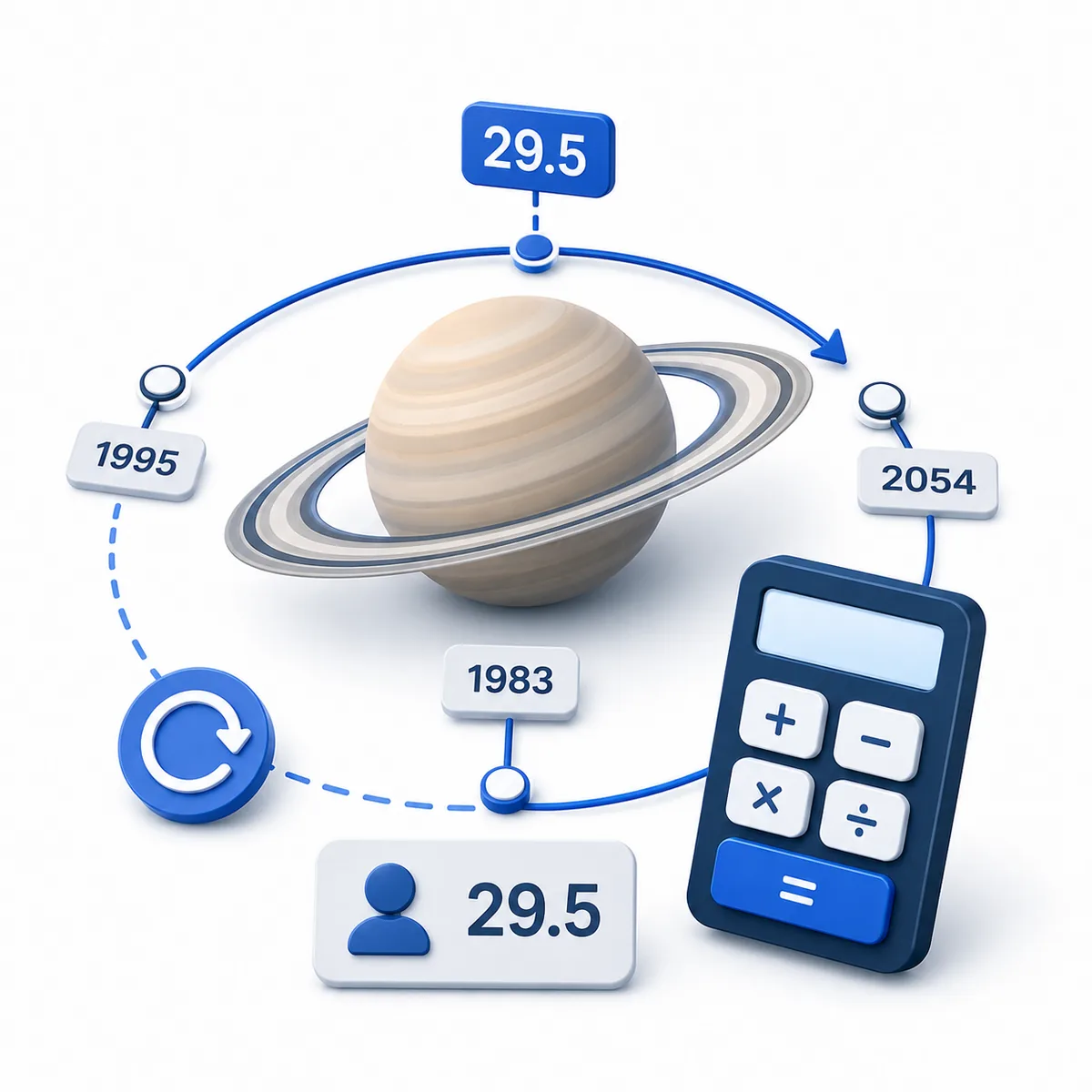
Saturn takes roughly 29.5 years to orbit the Sun. This calculator adds Saturn's average orbital period to the birth date for each cycle and shows a broad timing window around the estimate.
Variable explanations
Understand what each input and result means before calculating.
Birth date
The date used as the starting point for the estimated Saturn cycle.
Reference date
The date used to determine age and the next estimated return.
Saturn cycle
An average orbital period of about 29.4571 tropical years.
Timing window
A broad estimate around the center date, not an exact transit.
Timeline status
Whether the reference date is before, inside, or after each estimated return window.
Nearest return
The return cycle with the center date closest to the reference date.
Reviewed by the Calculator.org.in Editorial Team
Formula behavior, validation cases, explanatory examples, and cited sources are checked before publication. This review supports educational accuracy and is not a substitute for qualified professional advice.
Last reviewed: 2026-08-25
Formula guide
See the calculation logic, variable definitions, and practical meaning.
Estimated return date
Return date = birth date + 29.4571 years x cycle
- Cycle 1 is the first return.
- Cycle 2 and 3 estimate later returns.
This is an average-period approximation, not an ephemeris calculation.
Estimated window
Window = estimated return date +/- 1.5 years
- The broad window reflects common Saturn return timing discussions.
Exact chart-based timing can include multiple passes because of retrograde motion.
Age on reference date
Age = days between birth date and reference date / 365.2425
- Reference date can be today or another date.
This helps show whether the next estimated return is near, past, or far ahead.
Timeline status
Status = reference date compared with each return window
- Before window means the broad timing period has not started.
- Inside broad window means the reference date falls inside the approximate return period.
- After window means that cycle's broad period has passed.
A Saturn return is commonly discussed as a period, so the timeline table is more useful than a single date alone.
Worked examples
Follow realistic inputs through the calculation step by step.
Worked example
First return
- 1Enter a birth date.
- 2Use the reference date.
- 3Review the cycle 1 estimate near the late 20s.
Worked example
Second return
- 1Check the cycle 2 estimate.
- 2Compare it with the reference date.
- 3Review the broad timing window.
Worked example
Third return
- 1Review the cycle 3 estimate.
- 2Use it as a general timeline.
- 3Avoid treating the date as exact.
Worked example
Reference date check
- 1Set a future reference date.
- 2Calculate again.
- 3See which return is next from that date.
Worked example
Currently in the window
- 1Enter a reference date near the late 20s, late 50s, or late 80s.
- 2Review the timeline status table.
- 3Use the broad window instead of treating the center date as one exact event.
Worked example
Comparing average and chart timing
- 1Use this page for a fast average-orbit estimate.
- 2Use an ephemeris-based birth chart when you need exact natal Saturn degree timing.
- 3Expect retrograde motion to create multiple exact passes in some charts.
Common mistakes
Avoid these common input and interpretation errors.
Treating this as exact astrology
Exact return timing requires birth time, location, and ephemeris calculations.
Ignoring retrogrades
Chart-based Saturn returns can involve more than one exact pass.
Treating the center date as the whole return
Many astrology sources describe Saturn return as a window or season, not only one calendar date.
Mixing tropical and sidereal systems
Western tropical and Vedic sidereal astrology can frame sign and timing details differently.
Reading the result as advice
The calculator gives dates only, not life, legal, financial, health, or relationship advice.
Using an uncertain birth date
A wrong birth date changes every estimated return date.
Frequently asked questions
Quick answers to the questions users ask most often.
What does this Saturn Return Calculator calculate?
Is this an exact astrology chart?
How often does Saturn return happen?
When is the first Saturn return?
When is the second Saturn return?
When is the third Saturn return?
Why is there a broad window?
Why can the nearest return differ from the next return?
Why do some calculators show multiple exact dates?
Do I need birth time?
Do I need birth location?
Is this a Vedic Saturn return calculator?
Does this show my Saturn sign?
Can the exact date differ?
Is Saturn return astronomy or astrology?
Can this predict life events?
Can I use a future reference date?
Is this advice?
References
Sources used to support the calculator guidance.
Related calculators
Continue with calculators that solve nearby problems.
Version history
A transparent record of calculator content updates.
- 1.2.0 · 2026-08-25
Added a result-aware cycle summary, clearer ephemeris accuracy limits, and a current reference-date default based on Search Console intent analysis.
- 1.1.0 · 2026-08-03
Added timeline status, nearest-window explanation, accuracy notes, and SERP-informed guidance around exact chart limits.
- 1.0.0 · 2026-07-05
Initial Saturn return timing estimator release.