Volume Calculator
Calculate volume for 12 common solids with shape-specific dimensions, formulas, and substitution steps.
- solid volume calculator
- 3d shape volume calculator
- pyramid volume calculator
- frustum volume calculator
- ellipsoid volume calculator
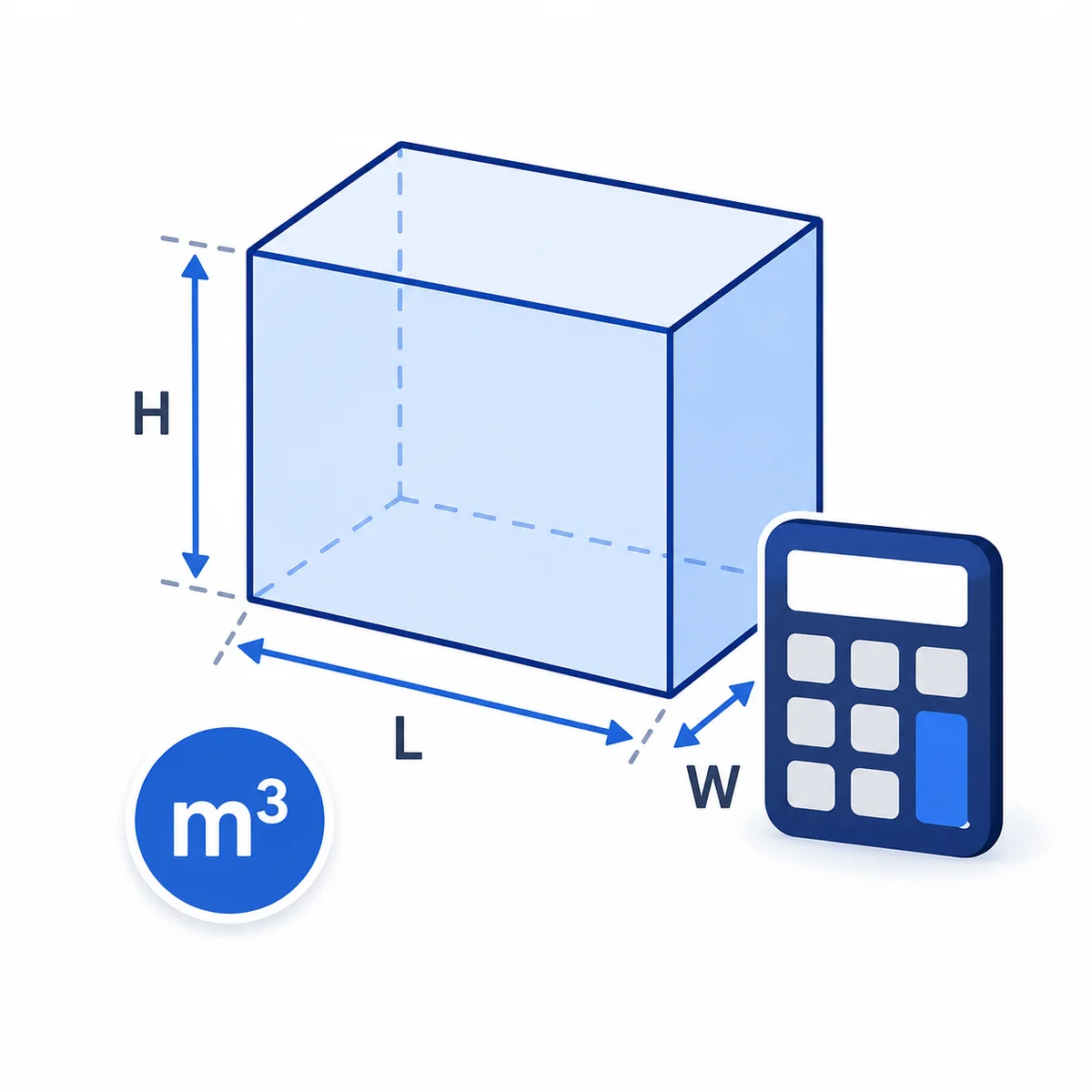
Choose the three-dimensional solid whose volume you want to calculate.
Prism length or rectangular base length.
Prism width or rectangular base width.
Perpendicular height of the selected solid.
Status: initial
Results
Awaiting calculation
Calculated volume scale
Compare the selected solid's calculated volume while keeping its dimensions, formula, and substitution steps visible.
Use this result well
- 1Choose the solid that matches the object.
- 2Enter all dimensions in one consistent unit.
- 3Check the formula and substitution before using the volume.
Volume scales in three dimensions: doubling every linear dimension multiplies volume by eight.
Introduction
The Volume Calculator measures the three-dimensional space inside 12 common solids. Choose a solid and the form displays only the dimensions required by that formula. Volume measures three-dimensional capacity in cubic units; selecting the correct solid determines which dimensions and constants the calculation uses.
When to use a volume calculator
Use it for geometry, containers, tanks, pipes, packaging, material estimates, and solid comparisons. Keep every dimension in one length unit so the result is expressed in the corresponding cubic unit. For real containers or bulk materials, treat the geometric volume as a baseline and account separately for wall thickness, unusable space, settlement, or overfill.
How volume is calculated
Prisms multiply base area by length or height. Pyramids and cones use one third of the matching prism or cylinder, while spheres, frustums, tubes, and ellipsoids use their own radius-based relationships. Cylinder and cone formulas use the circular base area πr²; a cone has one third of the volume of a cylinder with the same base and height.
Variable explanations
Understand what each input and result means before calculating.
Solid
Controls the formula and visible dimension fields.
Length, width, and height
Use perpendicular dimensions, not slanted edges.
Side length
The common edge of a cube or one side of a square pyramid base.
Radius
Distance from the centre to a circular edge; it is half the diameter.
Outer and inner radii
The inner radius must be smaller than the outer radius.
Triangular end
Its base and perpendicular height determine the cross-sectional area.
Prism length
Distance between matching triangular ends.
Ellipsoid semi-axes
Half of each full centre-line diameter along the three axes.
Reviewed by the Calculator.org.in Editorial Team
Formula behavior, validation cases, explanatory examples, and cited sources are checked before publication. This review supports educational accuracy and is not a substitute for qualified professional advice.
Last reviewed: 2026-08-23
Formula guide
See the calculation logic, variable definitions, and practical meaning.
Rectangular prism and cube
Prism: V = lwh; Cube: V = s³
- l is length.
- w is width.
- h is height.
- s is side length.
Multiply three perpendicular dimensions; a cube has three equal dimensions.
Cylinder and hollow cylinder
Cylinder: V = πr²h; Tube: V = πh(R² − r²)
- h is height.
- R is outer radius.
- r is radius or inner radius.
A tube subtracts the empty inner cylinder from the outer cylinder.
Sphere and hemisphere
Sphere: V = 4πr³/3; Hemisphere: V = 2πr³/3
- r is radius.
A hemisphere is exactly half a sphere before wall thickness or a flat base is considered.
Cone and conical frustum
Cone: V = πr²h/3; Frustum: V = πh(R² + Rr + r²)/3
- h is perpendicular height.
- R and r are the two base radii.
A frustum is the portion left after the top of a cone is cut parallel to its base.
Square and rectangular pyramids
Square: V = s²h/3; Rectangular: V = lwh/3
- h is perpendicular height.
- s, l, and w define the base.
A pyramid is one third of a prism with the same base and perpendicular height.
Triangular prism
V = bhL/2
- b and h define the triangular end.
- L is prism length.
Find the triangular base area, then multiply by the distance between the two ends.
Ellipsoid
V = 4πabc/3
- a, b, and c are the three semi-axes.
Each semi-axis is measured from the ellipsoid's centre to its surface.
Worked examples
Follow realistic inputs through the calculation step by step.
Worked example
Rectangular prism
- 1Choose Rectangular prism.
- 2Enter length 5, width 4, and height 10.
- 3The volume is 200 cubic units.
Worked example
Hollow cylinder
- 1Choose Hollow cylinder.
- 2Enter outer radius 5, inner radius 3, and height 10.
- 3The material volume is approximately 502.6548 cubic units.
Worked example
Conical frustum
- 1Choose Conical frustum.
- 2Enter radii 5 and 3 with height 10.
- 3The volume is approximately 513.1268 cubic units.
Worked example
Ellipsoid
- 1Choose Ellipsoid.
- 2Enter semi-axes 5, 3, and 2.
- 3The volume is approximately 125.6637 cubic units.
Worked example
Find sphere volume
- 1Choose sphere and enter radius 3.
- 2Cube the radius and multiply by 4π/3.
- 3The volume is approximately 113.0973 cubic units.
Worked example
Compare a cone with a cylinder
- 1Use radius 3 and height 10 for both solids.
- 2The cylinder volume is about 282.7433 cubic units.
- 3The matching cone volume is one third as large, about 94.2478 cubic units.
Common mistakes
Avoid these common input and interpretation errors.
Mixing units
Convert every dimension to the same length unit before calculating.
Using diameter as radius
Divide a diameter by two before entering a radius.
Using slant height
Cone and pyramid formulas require perpendicular height.
Reversing tube radii
The inner radius must be smaller than the outer radius.
Entering full ellipsoid axes
Enter semi-axes, which are half the full diameters.
Treating volume as capacity
Usable capacity can be lower because of walls, fittings, headspace, or inaccessible material.
Frequently asked questions
Quick answers to the questions users ask most often.
Which solids are supported?
Can I use centimetres, metres, inches, or feet?
Why do inputs change when I select a solid?
How do I use a diameter?
What is perpendicular height?
What is a conical frustum?
Does hollow-cylinder volume include the empty centre?
Can this calculate liquid capacity?
Why are volume units cubed?
Does the result account for wall thickness or unused space?
How do I use a diameter input?
Does geometric volume include container wall thickness?
References
Sources used to support the calculator guidance.
Related calculators
Continue with calculators that solve nearby problems.
Version history
A transparent record of calculator content updates.
- 2.0.0 · 2026-08-23
Expanded from 4 to 12 solids with conditional inputs, transparent formulas, calculation steps, validation, examples, and unique page content.
- 1.0.0 · 2026-08-03
Initial rectangular prism, cylinder, sphere, and cone calculator.