Density Calculator
Calculate density, mass, or volume with automatic SI and imperial conversion, geometric volume options, material references, significant figures, and uncertainty estimates.
- mass density volume
- rho m over v
- density formula
- material density
- g cm3 to kg m3
Used when the volume source is Direct, or as the result unit when calculating volume.
Used when calculating mass or volume with a manually entered density.
When calculating density, the result always comes from mass and volume.
Approximate comparison values at stated or typical conditions—not specifications.
Geometry applies when calculating density or mass. Calculated-volume mode uses V = m ÷ ρ.
Optional relative uncertainty for the entered mass.
Optional relative uncertainty for the entered or geometric volume.
Optional relative uncertainty for entered or reference density.
Status: initial
Results
Awaiting calculation
Density calculations with the units and assumptions exposed
The Density Calculator solves density, mass, or volume from the other two quantities. It converts metric and imperial units through SI base units, can derive volume for a cuboid, cylinder, or sphere, loads clearly labelled reference materials, compares results on a material scale, and estimates how entered measurement uncertainty affects the answer.
Use it for measurements, material estimates, and classroom checks
Use the calculator when identifying an unknown sample, estimating the mass of a known material, finding required capacity, checking a laboratory exercise, or translating density units. Reference presets are intentionally presented as typical comparison values because real materials vary with temperature, pressure, composition, grade, porosity, moisture, and manufacturing history.
Mass divided by occupied volume defines mass density
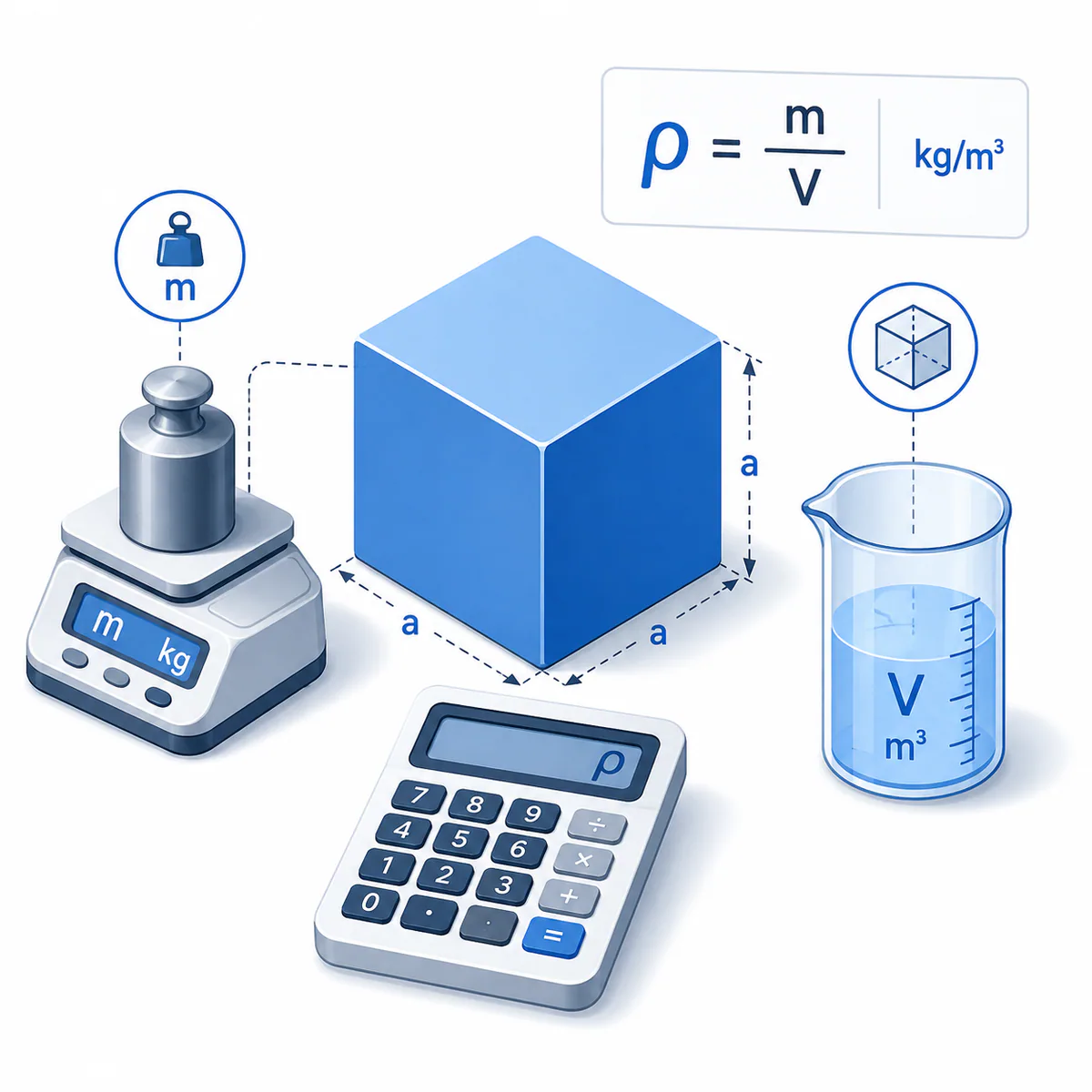
Mass density is represented by the Greek letter rho (ρ): ρ = m/V. Rearranging the same physical relationship gives m = ρV and V = m/ρ. The calculator converts inputs to kilograms and cubic metres before solving, then converts the answer into the selected display unit so mixed unit systems remain dimensionally consistent.
Variable explanations
Understand what each input and result means before calculating.
🎯 Quantity to calculate
Choose density, mass, or volume. The equation audit shows the rearranged relationship and all three internally consistent values.
⚖️ Mass
Enter mass in metric or US customary units. A scale may infer mass from force under calibration assumptions; mass and weight force are not interchangeable physical quantities.
🧊 Volume
Enter volume directly or derive it from ideal cuboid, cylinder, or sphere dimensions. Irregular, porous, hollow, or flexible objects need an appropriate measurement method.
ρ Density
Enter density manually or select a typical material when calculating mass or volume. When calculating density, mass and volume determine the result.
🧱 Material reference
Presets offer orientation across gases, liquids, construction materials, and metals. They are not grade-specific design values and cannot identify an unknown sample by themselves.
📐 Geometry
Geometry is used only when density or mass is calculated. When volume is the unknown, V = m/ρ is used and the dimension fields are ignored.
↔️ Unit conversion
Every calculation passes through kg, m³, and kg/m³. This prevents common factor-of-1,000 errors such as confusing g/cm³ with kg/m³.
± Measurement uncertainty
Enter relative uncertainty for each known quantity. The displayed range is a simple independent-input estimate, not a full uncertainty budget.
🔢 Significant digits
Choose how many significant digits appear in explanatory results. Reported precision should not exceed the quality of the underlying measurements.
Reviewed by the Calculator.org.in Editorial Team
Formula behavior, validation cases, explanatory examples, and cited sources are checked before publication. This review supports educational accuracy and is not a substitute for qualified professional advice.
Last reviewed: 2026-08-10
Formula guide
See the calculation logic, variable definitions, and practical meaning.
Density
ρ = m ÷ V
- ρ is mass density
- m is mass
- V is occupied volume
Divide measured mass by measured or calculated volume.
Mass
m = ρ × V
- Use a density representative of the actual material and conditions
- Mass is not gravitational force
Multiply density by volume to estimate the amount of matter.
Volume
V = m ÷ ρ
- Density must be positive
- The result is occupied volume at the stated conditions
Divide mass by density to estimate capacity or displacement.
Rectangular cuboid volume
V = L × W × H
- L, W, and H must share a length unit
Useful for solid rectangular samples without voids or cavities.
Cylinder volume
V = π(d ÷ 2)²h
- d is diameter
- h is cylinder height
The selected dimensions are converted to metres before volume is calculated.
Sphere volume
V = 4π(d ÷ 2)³ ÷ 3
- d is sphere diameter
This assumes a complete, geometrically ideal sphere.
Specific volume
ν = 1 ÷ ρ
- ν is volume per unit mass
Specific volume is the reciprocal of mass density and is displayed in m³/kg.
Relative density
RD = ρsample ÷ ρwater
- This page uses 998.2 kg/m³ as an approximate fresh-water reference near 20 °C
Relative density is dimensionless. A precise specific-gravity comparison requires an explicitly defined reference temperature and method.
Independent relative uncertainty
ur = √(u₁² + u₂²)
- Inputs are treated as independent relative percentages
- This is a first-order estimate
The relevant known quantities are combined by root-sum-square propagation. Correlation, bias, calibration, and model uncertainty are not included.
Worked examples
Follow realistic inputs through the calculation step by step.
Worked example
Density of an aluminum-sized sample
- 1Enter 540 g mass and 200 cm³ volume.
- 2Calculate density in g/cm³.
- 3The result is 2.7 g/cm³, or 2,700 kg/m³.
Worked example
Mass of one litre of water
- 1Choose Calculate mass and the water material reference.
- 2Enter 1 L as direct volume.
- 3Using the page's 20 °C reference, the estimated mass is about 0.9982 kg.
Worked example
Volume of a steel component
- 1Choose Calculate volume and the carbon-steel reference.
- 2Enter a mass of 15.7 kg.
- 3The result is approximately 0.002 m³, or 2 L.
Worked example
Cuboid volume before density
- 1Choose Calculate density and cuboid dimensions.
- 2Enter 10 cm × 5 cm × 4 cm and a 540 g mass.
- 3The geometry produces 200 cm³ before ρ = m/V is applied.
Worked example
Cylinder mass from a reference material
- 1Choose Calculate mass, cylinder volume, and a suitable material reference.
- 2Enter diameter and height with one dimension unit.
- 3Review the geometry audit and material assumption before using the mass estimate.
Worked example
Convert density units
- 1Calculate or enter a physically consistent case.
- 2Select g/cm³, kg/m³, or lb/ft³ as the result unit.
- 3The displayed number changes while the underlying density remains the same.
Worked example
Estimate measurement sensitivity
- 1For a density calculation, enter mass and volume uncertainty percentages.
- 2The calculator combines them by root-sum-square.
- 3Use the displayed range as an initial check, not a complete laboratory uncertainty statement.
Common mistakes
Avoid these common input and interpretation errors.
Using weight force as mass
Density uses mass. Newtons and pound-force describe force and need a gravitational acceleration to convert to mass.
Mixing cubic and linear conversions
A centimetre is 0.01 m, but a cubic centimetre is 10⁻⁶ m³—not 0.01 m³.
Treating g/cm³ and kg/m³ as equal numbers
1 g/cm³ equals 1,000 kg/m³. The same physical density has different numerical values in different units.
Assuming a reference value is exact
A generic label such as steel, concrete, wood, or ethanol covers variation in grade, composition, moisture, porosity, and conditions.
Ignoring temperature and pressure
Liquids and gases can change density appreciably with temperature or pressure; solids can change too when precision matters.
Using external dimensions for a hollow object
Bulk external volume and actual material volume answer different questions. Cavities and porosity change average density.
Using ideal geometry for an irregular sample
A nominal diameter or edge length may not represent true displaced volume. Use an appropriate displacement or metrology method.
Equating density with buoyant force
Average density helps predict float or sink tendency, but actual buoyant force requires displaced-fluid volume and gravity.
Reporting excessive precision
A long calculator result does not improve the precision of measured inputs. Use significant figures and uncertainty appropriate to the method.
Using density alone to identify a substance
Different substances and mixtures can share similar densities. Identification normally requires additional physical or chemical evidence.
Frequently asked questions
Quick answers to the questions users ask most often.
What is the formula for density?
How do I calculate mass from density?
How do I calculate volume from mass and density?
What is the SI unit of density?
Is 1 g/cm³ equal to 1 g/mL?
How many kg/m³ are in 1 g/cm³?
What is the difference between mass and weight?
Can I use dimensions instead of entering volume?
Why can a material's density vary?
What is specific volume?
What is relative density?
Does a density below water always mean an object floats?
Can this calculator identify an unknown material?
How is uncertainty estimated?
Are the material presets suitable for engineering design?
Does density change with temperature?
References
Sources used to support the calculator guidance.
- BIPM: The International System of Units, 9th edition
- NIST Special Publication 811: Guide for the Use of SI
- IUPAC Gold Book: mass density
- OpenStax Chemistry 2e: Physical and Chemical Properties
- OpenStax University Physics: Density and Pressure
- JCGM 100: Evaluation of measurement data—Guide to uncertainty
- NIST Chemistry WebBook
- USGS Water Science School: Water Density
- ASTM D792: Density and Specific Gravity of Plastics
- ASTM C29/C29M: Bulk Density of Aggregate
Related calculators
Continue with calculators that solve nearby problems.
Version history
A transparent record of calculator content updates.
- 1.0.0 · 2026-08-10
Initial release with three-variable solving, SI and imperial conversion, geometric volume, reference-material comparisons, specific volume, relative density, and first-order uncertainty propagation.