US LTL class
Class 100
Estimated from actual packaged density on the 13-tier scale.
Estimate US LTL freight class from actual packaged density and optionally compare actual, dimensional, and chargeable weight.
Length of one packaged unit in inches.
Width of one packaged unit in inches.
Height of one packaged unit in inches.
Actual packaged weight of one unit in pounds.
Number of matching packaged units.
Freight class always uses actual packaged weight. Turn on this optional comparison to estimate a separate pricing weight.
Status: initial
Freight class uses actual packaged density. The optional dimensional-weight comparison is a separate planning aid for carrier pricing.
Class 100
Estimated from actual packaged density on the 13-tier scale.
500 lb
This weight—not dimensional weight—is used to calculate freight density.
Select Compare actual and dimensional weight in the calculator to add a carrier-divisor comparison and estimated chargeable weight.
Commodity, handling, stowability, liability, carrier tariffs, and inspection can override a density-only estimate.
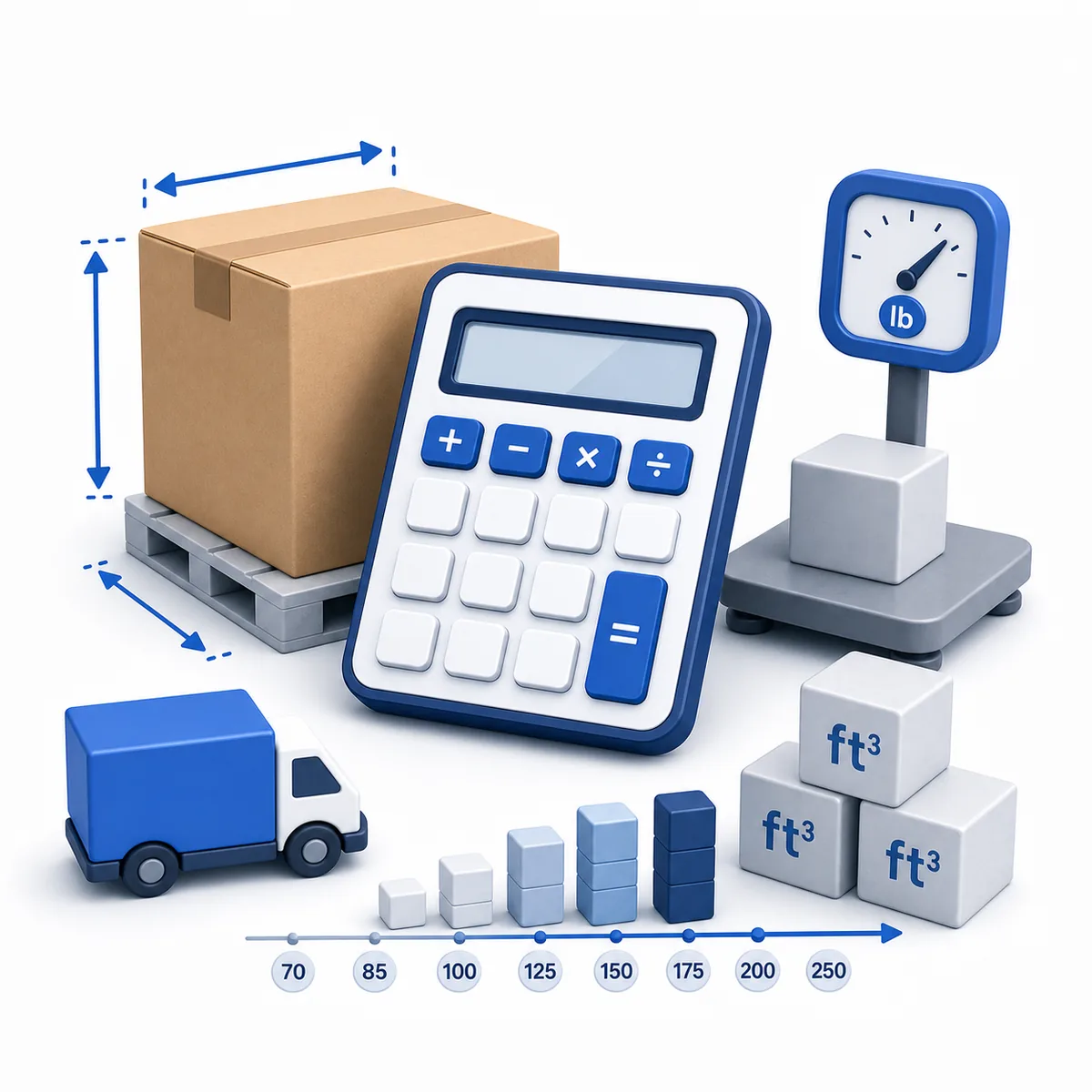
The US LTL Freight Class Calculator estimates density-based National Motor Freight Classification (NMFC) class from packaged dimensions, actual weight, and quantity using the current 13-tier density scale for qualifying freight. It can also compare actual and dimensional weight as a separate pricing aid.
Freight class is a United States less-than-truckload shipping category used to help price and handle freight. Density is a major input, but final NMFC classification can also depend on commodity, handling, stowability, liability, packaging, NMFC item notes, and carrier inspection.
The calculator converts packaged inches to cubic feet, multiplies by quantity, divides total actual shipment weight by total cubic feet, and maps pounds per cubic foot to the US LTL 13-tier density class scale. If requested, it separately calculates dimensional and estimated chargeable weight without changing the density-based class.
Understand what each input and result means before calculating.
The longest side of one packaged freight unit.
The width of one packaged freight unit.
The packaged height, including pallet or crate height if applicable.
The actual packaged weight of one unit in pounds.
How many identical packaged units are included in the shipment.
An optional comparison of shipment actual weight with dimensional weight. It does not change the freight class.
A carrier- and rate-specific number used to convert packaged cubic inches into an estimated pricing weight.
Total shipment pounds divided by total cubic feet.
The density-based class bracket before commodity-specific confirmation.
Formula behavior, validation cases, explanatory examples, and cited sources are checked before publication. This review supports educational accuracy and is not a substitute for qualified professional advice.
Last reviewed: 2026-08-24
See the calculation logic, variable definitions, and practical meaning.
Cubic feet = length x width x height / 1,728
Divide cubic inches by 1,728 because one cubic foot equals 1,728 cubic inches.
Total cubic feet = cubic feet per piece x quantity
Use separate calculations when pallets or crates have different dimensions.
Total weight = weight per unit x quantity
Use actual packaged weight for the density estimate.
Density = total weight / total cubic feet
Higher density usually maps to a lower freight class.
Class = 13-tier density bracket
Use this as a planning estimate and confirm final classification before shipping.
Measure the farthest packaged points
Carrier inspections often measure the full handling unit, not just the product.
Final class = density plus NMFC rules when applicable
Density-only output is not a substitute for NMFC item classification.
Dimensional weight = length x width x height / carrier divisor
This is a pricing comparison only. It does not replace actual packaged weight in the freight-density calculation.
Chargeable weight = greater of actual weight and dimensional weight
Confirm the billable weight on the carrier quote before booking.
Follow realistic inputs through the calculation step by step.
Worked example
Worked example
Worked example
Worked example
Worked example
Avoid these common input and interpretation errors.
Measure the full shipping unit, including pallet, crate, wrapping, bulges, or overhang.
Density does not always determine the final NMFC class.
Total density should use the full shipment volume and weight when units are identical.
Different pallet sizes or weights should be calculated separately or from exact shipment totals.
Small measurement changes can shift density near a class boundary.
Many current density-only references use the 13-tier scale where less than 1 lb/ft3 maps to class 400, while commodity-specific classes may still differ.
Incorrect class can lead to reclassification, adjusted charges, or disputes after inspection.
Use actual packaged weight for density-based class. Dimensional weight is shown separately as a pricing comparison.
Divisors, dimension rounding, minimums, and cubic-capacity rules vary by carrier, account, service, and tariff.
Quick answers to the questions users ask most often.
Sources used to support the calculator guidance.
Continue with calculators that solve nearby problems.
A transparent record of calculator content updates.
Clarified the US LTL scope and added an optional actual-versus-dimensional chargeable-weight comparison with carrier-specific caveats.
Updated to the 13-tier density scale and added density chart, measurement checklist, reclassification risk checks, and expanded NMFC guidance.
Initial freight class calculator release.