Integral Calculator
Find antiderivatives and definite integrals for nine polynomial, power, trigonometric, exponential, logarithmic, radical, reciprocal, and constant families.
- integration calculator
- antiderivative calculator
- definite integral calculator
- trigonometric integral calculator
- area under curve calculator
Use non-negative whole-number powers, such as 6x + 2 or 3x^2 − 4x + 1.
Starting x value for the definite integral.
Ending x value. Reversed bounds produce the negative integral.
Status: initial
Results
Awaiting calculation
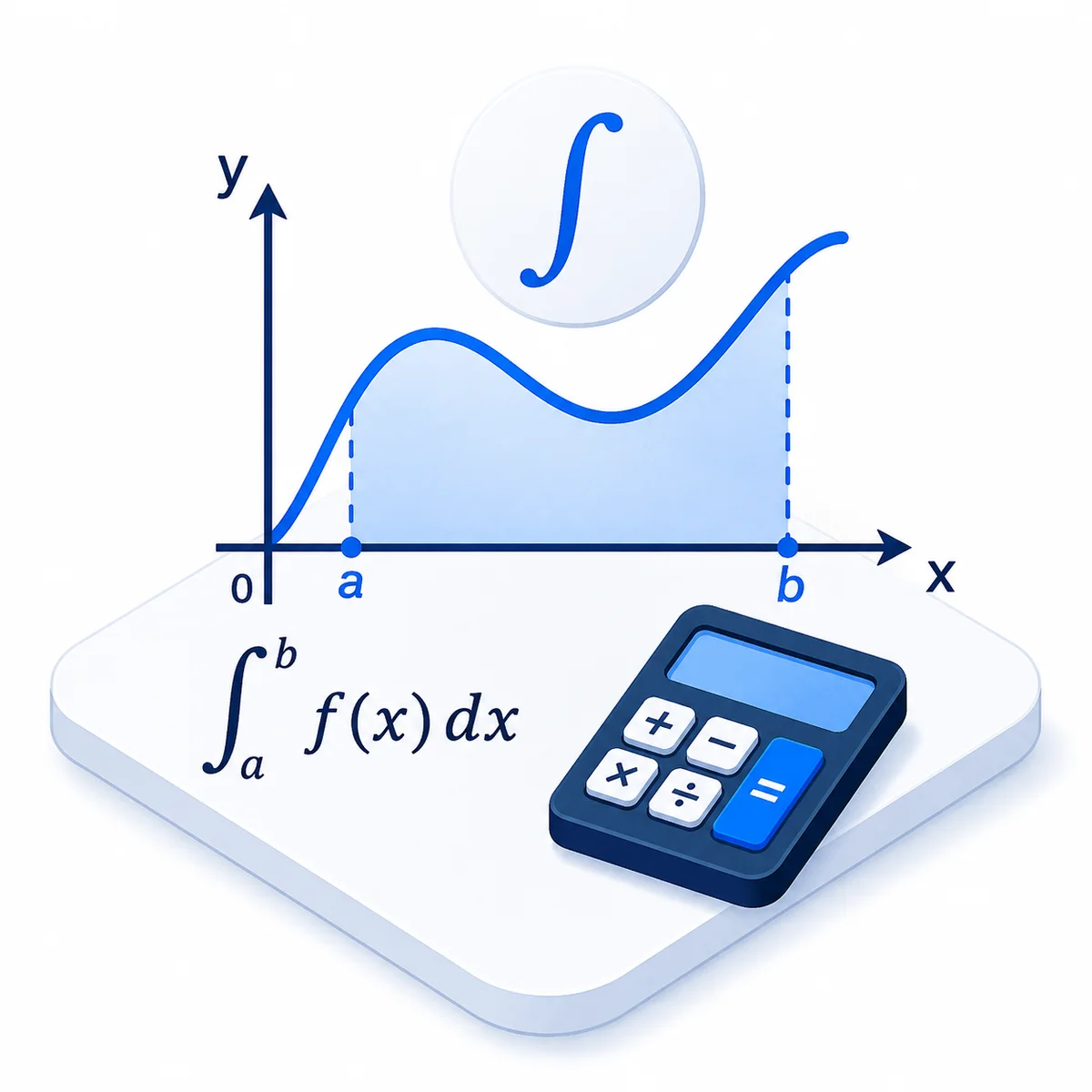
Integral as accumulated change
Compare signed accumulation while keeping the selected family, antiderivative rule, bounds, and endpoint values visible.
Use this result well
- 1Choose the matching function family.
- 2Check coefficients and bounds against the real domain.
- 3Review F(upper) and F(lower) before using their difference.
Reversing bounds changes the sign; a signed integral is not always the same as total geometric area.
Integral calculator for nine function families
Choose a supported function family to find its symbolic antiderivative and evaluate a definite integral between two bounds. Conditional inputs keep each integration rule explicit. The guided selector returns both a symbolic antiderivative and the signed net accumulation between the supplied bounds for each supported function family.
When to use this integral calculator
Use it to check introductory calculus work involving polynomials, powers, reciprocal, sine, cosine, e-based exponential, natural logarithm, square root, and constant functions. It is a guided rule calculator, not an unrestricted computer algebra system. Use it to check introductory integration across the supported polynomial, power, trigonometric, exponential, logarithmic, radical, reciprocal, and constant families. It does not claim arbitrary symbolic substitution or advanced identities.
How integration is applied
The calculator builds an antiderivative F(x), includes the constant + C, then calculates F(upper) − F(lower). It validates real-number domains and rejects intervals containing singularities such as x = 0 for reciprocal functions. Each family applies its documented antiderivative rule. Every indefinite result includes + C, while the definite integral subtracts the lower antiderivative value from the upper value.
Variable explanations
Understand what each input and result means before calculating.
Function family
Selects the integration rule and relevant parameter fields.
Coefficient a
An outer multiplier carried through the antiderivative.
Exponent n
Power in a·xⁿ; exponent −1 uses the reciprocal logarithm rule.
Inner coefficient b
Multiplier in bx that becomes a divisor during integration.
Bounds
Lower and upper x values used in F(upper) − F(lower).
Reviewed by the Calculator.org.in Editorial Team
Formula behavior, validation cases, explanatory examples, and cited sources are checked before publication. This review supports educational accuracy and is not a substitute for qualified professional advice.
Last reviewed: 2026-08-23
Formula guide
See the calculation logic, variable definitions, and practical meaning.
Polynomial and power
∫axⁿ dx = a·xⁿ⁺¹/(n + 1) + C, n ≠ −1
- a is coefficient.
- n is exponent.
Apply the rule term by term for a polynomial.
Reciprocal
∫a/x dx = a ln|x| + C
- The interval cannot contain x = 0.
The exponent −1 is the logarithmic exception to the normal power rule.
Sine
∫a sin(bx) dx = −(a/b) cos(bx) + C
- b must be non-zero.
- Angles use radians.
Divide by the inner coefficient and introduce a negative cosine.
Cosine
∫a cos(bx) dx = (a/b) sin(bx) + C
- b must be non-zero.
- Angles use radians.
Divide by the inner coefficient b.
Exponential
∫a e^(bx) dx = (a/b)e^(bx) + C
- b must be non-zero.
The e-based exponential retains its form while dividing by b.
Natural logarithm
∫a ln(x) dx = a[x ln(x) − x] + C
- Bounds must be greater than zero.
This identity follows from integration by parts.
Square root and constant
∫a√x dx = (2a/3)x³ᐟ² + C; ∫a dx = ax + C
- Square-root bounds must be non-negative.
Square root is x¹ᐟ²; a constant gains a factor of x.
Worked examples
Follow realistic inputs through the calculation step by step.
Worked example
Polynomial
- 1Choose Polynomial and enter 6x + 2.
- 2The antiderivative is 3x^2 + 2x + C.
- 3From 0 to 2, the definite integral is 16.
Worked example
Reciprocal
- 1Choose Reciprocal with a = 2.
- 2Use bounds 1 and e.
- 3The definite integral is 2ln(e) − 2ln(1) = 2.
Worked example
Sine
- 1Choose Sine with a = 2 and b = 3.
- 2The antiderivative is −(2/3)cos(3x) + C.
- 3Evaluate it at each bound using radians.
Worked example
Natural logarithm
- 1Choose Natural logarithm with a = 1.
- 2Use bounds 1 and e.
- 3The definite integral equals 1.
Worked example
Find an indefinite polynomial integral
- 1Enter 3x^2 - 4x + 5.
- 2Integrate each term independently.
- 3The antiderivative is x³ - 2x² + 5x + C.
Worked example
Interpret reversed bounds
- 1Enter x and compare bounds 0 to 2 with bounds 2 to 0.
- 2The first definite integral is 2.
- 3Reversing the bounds changes only the sign, producing −2.
Common mistakes
Avoid these common input and interpretation errors.
Forgetting + C
An indefinite integral represents a family of antiderivatives differing by a constant.
Using the power rule at n = −1
The reciprocal case integrates to a logarithm instead.
Ignoring the inner coefficient
Sine, cosine, and exponential antiderivatives divide by b.
Crossing a singularity
A reciprocal or negative-power interval containing zero is improper and cannot use the ordinary endpoint formula.
Treating signed integral as total area
Regions below the x-axis subtract from the definite integral.
Frequently asked questions
Quick answers to the questions users ask most often.
Which integral functions are supported?
Why is + C included?
Can the definite integral be negative?
Are trigonometric bounds in degrees or radians?
Why is a reciprocal interval containing zero rejected?
Does this calculate total geometric area?
Why is + C needed for an indefinite integral?
Can a definite integral be negative?
Is a definite integral always geometric area?
References
Sources used to support the calculator guidance.
Related calculators
Continue with calculators that solve nearby problems.
Version history
A transparent record of calculator content updates.
- 2.0.0 · 2026-08-23
Expanded from polynomial-only integration to nine guided function families with conditional parameters, domain validation, symbolic antiderivatives, definite intervals, and endpoint steps.
- 1.0.0 · 2026-08-03
Initial polynomial antiderivative and definite integral calculator.