Mixed Number Calculator
Add, subtract, multiply, divide, simplify, or convert mixed numbers, whole numbers, proper fractions, and improper fractions with step-by-step results.
- mixed numbers
- mixed fractions
- improper fractions
- fraction arithmetic
- add mixed numbers
Whole-number part of the first mixed number.
Fraction numerator for the first value. It can be larger than the denominator.
Fraction denominator for the first mixed number.
Choose an arithmetic operation or convert and simplify the first value only.
Whole-number part of the second mixed number.
Fraction numerator for the second value. It can be larger than the denominator.
Fraction denominator for the second mixed number.
Status: initial
Results
Awaiting calculation
See the exact fraction equation
Follow both mixed numbers into improper-fraction form, apply the operation, simplify, and convert back.
Use this result well
- 1Convert both values to improper fractions.
- 2Apply the selected fraction operation.
- 3Convert the exact result back to mixed-number form.
The fraction result is exact; decimal and percent forms may be rounded when the value repeats.
Introduction
The Mixed Number Calculator adds, subtracts, multiplies, divides, simplifies, or converts mixed numbers, whole numbers, proper fractions, and improper fractions. It shows the answer as a mixed number, improper fraction, decimal, and percent with step-by-step work.
What is a mixed number?
A mixed number combines a whole number and a fraction, such as 1 2/3. Mixed numbers are often converted to improper fractions before arithmetic because fraction operations are easier and less error-prone in that form.
How this mixed number calculator works
The calculator converts each input to an improper fraction, applies the selected operation when needed, simplifies by the greatest common factor, then converts the result back to mixed-number form. Conversion mode works with one value; addition and subtraction show common-denominator context, while division shows the reciprocal.
Variable explanations
Understand what each input and result means before calculating.
Whole number
The whole-number part of a mixed number. Use 0 for a fraction-only input.
Numerator
The top part of the fractional part. It may be larger than the denominator if you are entering an improper fraction.
Denominator
The bottom part of the fractional part. It must be positive.
Operation
The arithmetic operation: add, subtract, multiply, or divide.
Improper fraction
A fraction where the numerator can be larger than or equal to the denominator.
Common denominator
A shared denominator used for adding or subtracting fractions.
Reciprocal
The flipped form of a fraction, used when dividing.
Simplification factor
The greatest common factor used to reduce the final fraction.
Reviewed by the Calculator.org.in Editorial Team
Formula behavior, validation cases, explanatory examples, and cited sources are checked before publication. This review supports educational accuracy and is not a substitute for qualified professional advice.
Last reviewed: 2026-08-25
Formula guide
See the calculation logic, variable definitions, and practical meaning.
Convert mixed number to improper fraction
Improper numerator = whole x denominator + numerator
- Keep the same denominator.
- Use the sign of the whole number.
This prepares mixed numbers for fraction arithmetic.
Add fractions
a/b + c/d = (a x d + c x b) / (b x d)
- A common denominator is required.
Use this for adding mixed numbers after converting them to improper fractions.
Subtract fractions
a/b - c/d = (a x d - c x b) / (b x d)
- A common denominator is required.
Subtraction can produce a negative mixed-number result.
Multiply fractions
a/b x c/d = (a x c) / (b x d)
- No common denominator is needed.
Multiply numerators and denominators, then simplify.
Divide fractions
a/b / c/d = a/b x d/c
- The second fraction is flipped to its reciprocal.
Division by a fraction becomes multiplication by the reciprocal.
Simplify fraction
Divide numerator and denominator by their GCF
- GCF is the greatest common factor.
This reduces the answer to lowest terms.
Improper fraction to mixed number
whole = numerator div denominator; remainder = numerator mod denominator
- The denominator stays the same.
This rewrites an improper fraction as a whole number plus a proper fraction.
Worked examples
Follow realistic inputs through the calculation step by step.
Worked example
Add mixed numbers
- 11 2/3 becomes 5/3.
- 21 3/4 becomes 7/4.
- 35/3 + 7/4 = 41/12.
- 441/12 = 3 5/12.
Worked example
Subtract mixed numbers
- 11 1/4 becomes 5/4.
- 22 1/2 becomes 5/2.
- 35/4 - 5/2 = -5/4.
- 4-5/4 = -1 1/4.
Worked example
Multiply mixed numbers
- 12 1/2 becomes 5/2.
- 21 1/3 becomes 4/3.
- 35/2 x 4/3 = 20/6.
- 420/6 simplifies to 3 1/3.
Worked example
Divide mixed numbers
- 1Convert both mixed numbers to improper fractions.
- 2Flip the second fraction to its reciprocal.
- 3Multiply and simplify the result.
Worked example
Improper fraction input
- 1Enter whole number 0 if the value is only a fraction.
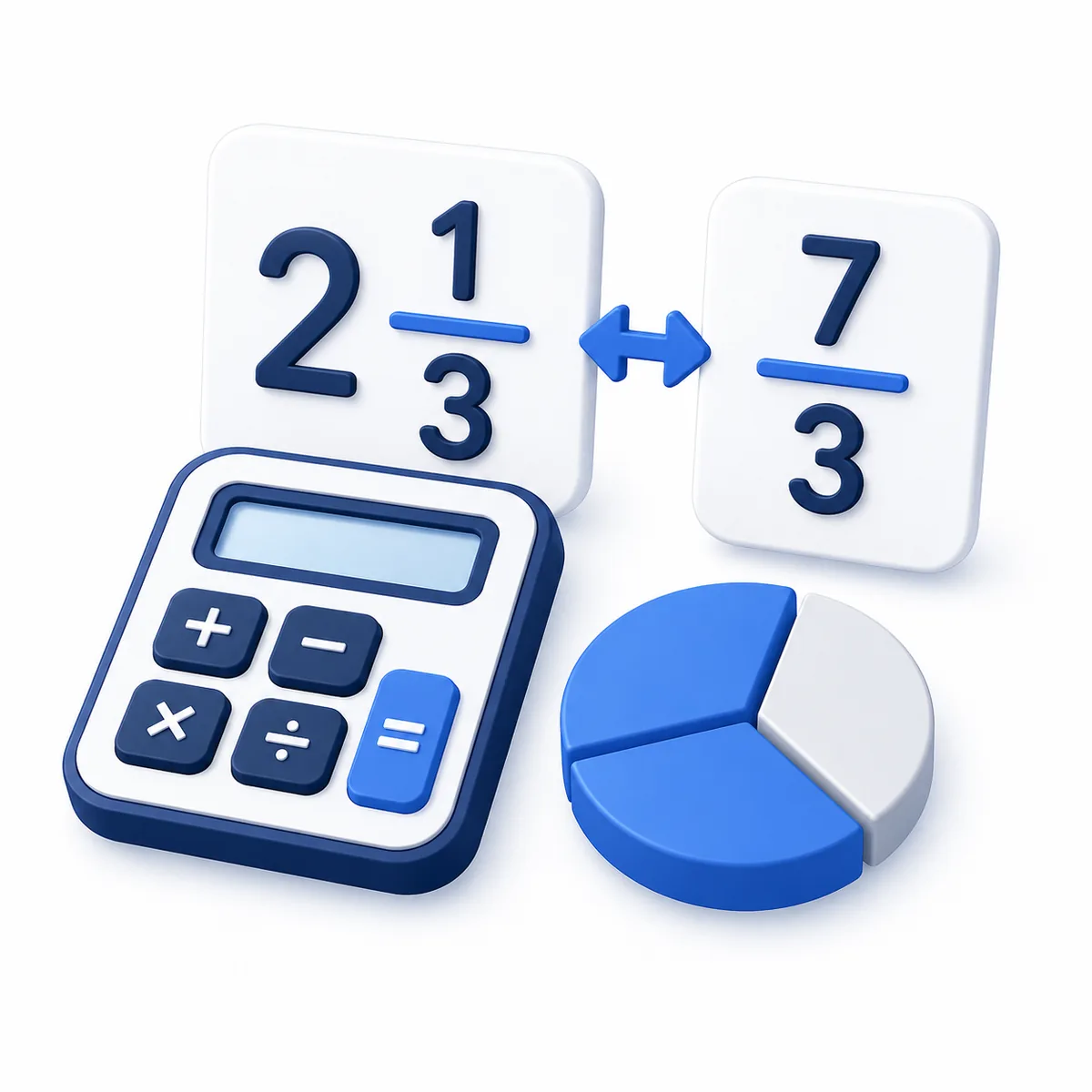
- 2Use numerator 7 and denominator 3 for 7/3.
- 3The result table shows 7/3 as 2 1/3.
Worked example
Convert one mixed number
- 1Choose Convert or simplify first value.
- 2Enter 2 as the whole number, 3 as numerator, and 4 as denominator.
- 3The calculator shows 2 3/4 = 11/4 = 2.75.
Common mistakes
Avoid these common input and interpretation errors.
Adding denominators
When adding or subtracting fractions, do not add denominators. Use a common denominator.
Adding whole parts and fractions separately without checking
This can work only when the fraction arithmetic is handled correctly, especially for unlike denominators or borrowing.
Forgetting to convert before multiplying
Mixed numbers should be converted to improper fractions before multiplication or division.
Dividing without using the reciprocal
Fraction division means multiplying by the reciprocal of the second fraction.
Leaving answers unsimplified
Simplify the final fraction and convert to mixed form when appropriate.
Confusing negative mixed numbers
A value like -1 2/3 means the whole mixed number is negative, not only the whole part.
Treating a decimal as exact
Some fraction results have repeating decimals, so the fraction form is often the exact answer.
Frequently asked questions
Quick answers to the questions users ask most often.
What does this Mixed Number Calculator do?
What is a mixed number?
How do you convert a mixed number to an improper fraction?
How do you convert an improper fraction to a mixed number?
Can this calculator simplify fractions?
Can it show an improper fraction?
Can it show decimals and percents?
Can I subtract mixed numbers?
Can I multiply mixed numbers?
Can I divide mixed numbers?
Can the result be negative?
Can the numerator be larger than the denominator?
Can I enter a whole number only?
Why convert to improper fractions first?
What is a common denominator?
What is a reciprocal?
Does this use lowest terms?
Is this only for positive numbers?
Why is the decimal rounded?
Can this compare fractions?
Can this solve equations with fractions?
Can I convert or simplify just one mixed number?
References
Sources used to support the calculator guidance.
Related calculators
Continue with calculators that solve nearby problems.
Version history
A transparent record of calculator content updates.
- 1.2.0 · 2026-08-25
Added standalone conversion and simplification mode, exact fraction transformation visuals, and refreshed mixed-fraction search metadata.
- 1.0.0 · 2026-07-06
Initial mixed number calculator release.
- 1.1.0 · 2026-08-03
Added improper fraction input support, percent output, common denominator, reciprocal, simplification factor, conversion check, and operation guide outputs.