Proportion Calculator
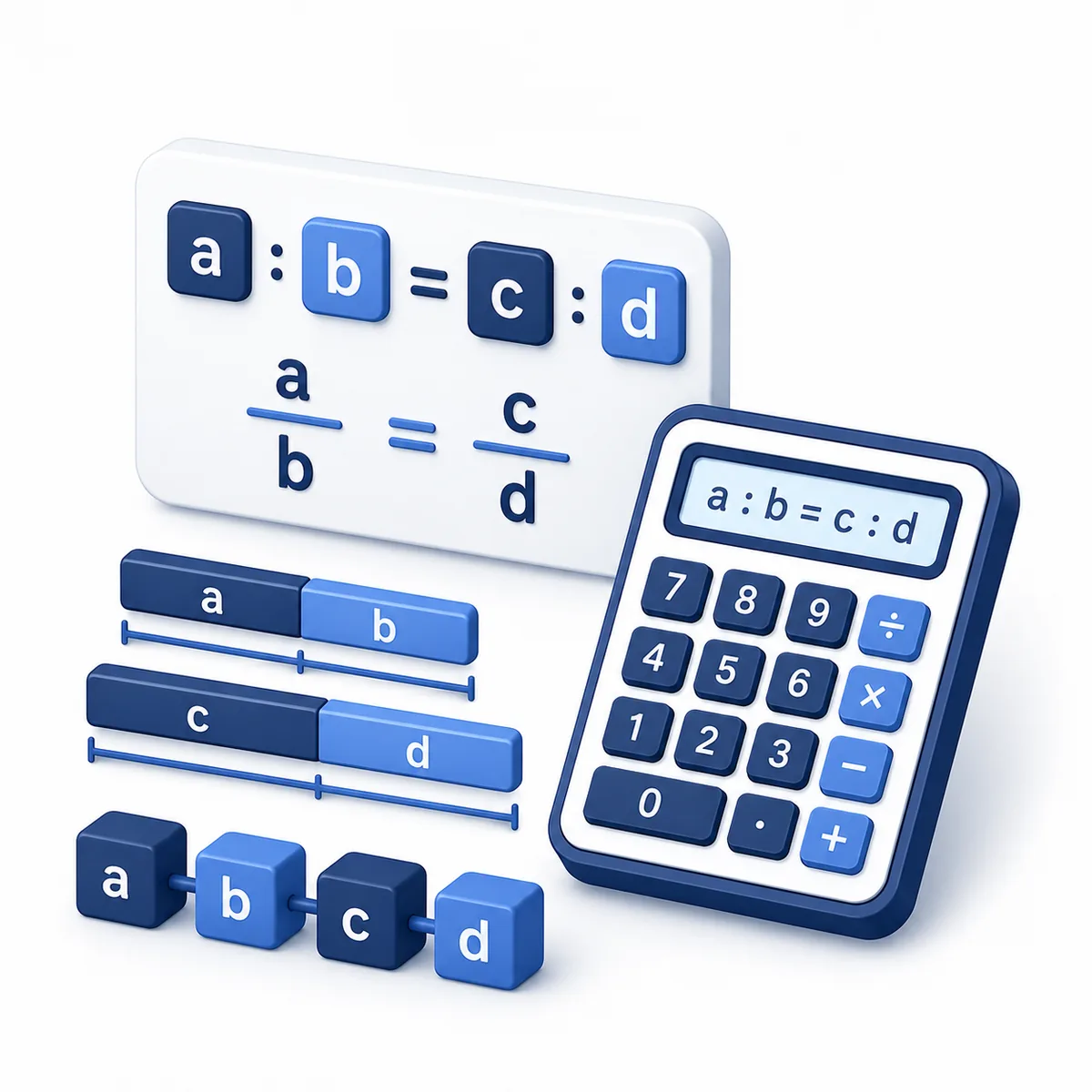
Solve a missing value in a proportion A/B = C/D using cross multiplication.
- proportion
- cross multiplication
- solve proportion
- equivalent ratios
- missing value
Choose which value to solve in A / B = C / D.
First numerator in A / B = C / D.
First denominator in A / B = C / D.
Second numerator in A / B = C / D.
Status: initial
Results
Awaiting calculation
D = 15 completes the proportion
3/5 = 9/15. Cross multiplication verifies the result because the two cross-products are 45 = 45.
Solve and verify the proportion
- 1Choose the unknown position, then enter only the three known values.
- 2Cross-multiply A x D = B x C and divide to isolate the missing value.
- 3Confirm both ratios and both cross-products are equal before using the scale.
A proportion is valid only when corresponding quantities and units appear in the same order on both sides.
Introduction
The Proportion Calculator solves one missing value in A / B = C / D using cross multiplication, then checks equivalent ratios, cross products, scaling factor, decimal ratio, percent form, and common real-world interpretations.
What is a proportion?
A proportion states that two ratios or fractions are equal. Proportions are used for recipe scaling, maps, model sizes, unit rates, percentages, and similar-figure problems.
Cross multiplication method
For A / B = C / D, cross multiply to get A x D = B x C. Rearrange that equation to solve for whichever value is missing, then substitute the result back into both ratios to check the answer.
Variable explanations
Understand what each input and result means before calculating.
A
First numerator in the proportion.
B
First denominator in the proportion.
C
Second numerator in the proportion.
D
Second denominator in the proportion.
Cross products
The products A x D and B x C.
Scaling factor
How one corresponding value scales to the other.
Equivalent ratios
Ratios that simplify to the same relationship.
Reviewed by the Calculator.org.in Editorial Team
Formula behavior, validation cases, explanatory examples, and cited sources are checked before publication. This review supports educational accuracy and is not a substitute for qualified professional advice.
Last reviewed: 2026-08-25
Formula guide
See the calculation logic, variable definitions, and practical meaning.
Solve for A
A = (B x C) / D
- B, C, and D are known.
- D cannot be zero.
Use this when the first numerator is missing.
Solve for B
B = (A x D) / C
- A, C, and D are known.
- C cannot be zero.
Use this when the first denominator is missing.
Solve for C
C = (A x D) / B
- A, B, and D are known.
- B cannot be zero.
Use this when the second numerator is missing.
Solve for D
D = (B x C) / A
- A, B, and C are known.
- A cannot be zero.
Use this when the second denominator is missing.
Cross product check
A x D = B x C
- Both products should match after solving.
Use this to verify that the completed proportion is true.
Scaling factor
Scale factor = C / A
- A and C should be corresponding values.
This shows how much the first numerator scales to the second numerator.
Ratio as percent
Percent = (A / B) x 100
- The same percent should appear on both sides of a true proportion.
Use this when a proportion represents rates, shares, or percent problems.
Worked examples
Follow realistic inputs through the calculation step by step.
Worked example
Solve for D
- 13 / 5 = 9 / D
- 2D = (5 x 9) / 3
- 3D = 15.
Worked example
Solve for A
- 1A / 8 = 6 / 12
- 2A = (8 x 6) / 12
- 3A = 4.
Worked example
Scale a recipe
- 12 cups for 3 servings and x cups for 9 servings.
- 22 / 3 = x / 9.
- 3x = 6 cups.
Worked example
Map or model scale
- 1If 3.5 inches on a model represents 100 inches in real life, set 3.5 / 100 = model / actual.
- 2Enter the three known values in matching positions.
- 3The missing value keeps the scale proportional.
Common mistakes
Avoid these common input and interpretation errors.
Using zero as a denominator
B and D cannot be zero in A / B = C / D.
Cross multiplying the wrong pairs
Multiply A by D and B by C.
Forgetting to divide after cross multiplication
After multiplying the known cross pair, divide by the remaining known value.
Mixing units
Ratios should compare compatible units or clearly converted values.
Putting values in mismatched positions
Corresponding quantities must occupy matching numerator or denominator positions.
Using direct proportion for inverse relationships
This calculator solves direct proportions. Inverse proportions need a different setup.
Treating rounded decimals as exact
If your inputs are rounded, the solved value is also based on rounded information.
Frequently asked questions
Quick answers to the questions users ask most often.
What does this Proportion Calculator do?
What is a proportion?
What is cross multiplication?
How do I solve for D?
How do I solve for A?
How do I solve for B?
How do I solve for C?
Can denominators be zero?
Can I use decimals?
Can I use negative numbers?
What does A / B = C / D mean?
What is the scaling factor?
Why show the percent form?
Can this scale recipes?
Can this solve map scale problems?
Can this solve model scale problems?
Can this solve inverse proportions?
How do I check the answer?
Is this the same as a ratio calculator?
Can this compare two ratios?
Can this solve complex algebraic proportions?
References
Sources used to support the calculator guidance.
Related calculators
Continue with calculators that solve nearby problems.
Version history
A transparent record of calculator content updates.
- 1.2.0 · 2026-08-25
Simplified the form to show exactly three known values and added result-aware ratio verification guidance.
- 1.1.0 · 2026-08-03
Added scaling factor, equivalent ratio, percent form, ratio comparison, application examples, table steps, and expanded cross-multiplication guidance.
- 1.0.0 · 2026-07-06
Initial proportion calculator release.