LCM Calculator
Find the least common multiple of two or more whole numbers, with prime factors and steps.
- least common multiple
- common multiple
- lcm
- least common denominator
- prime factors
Use non-zero whole numbers. Negative values are treated by absolute value.
Status: initial
Results
Awaiting calculation
Find where every number meets
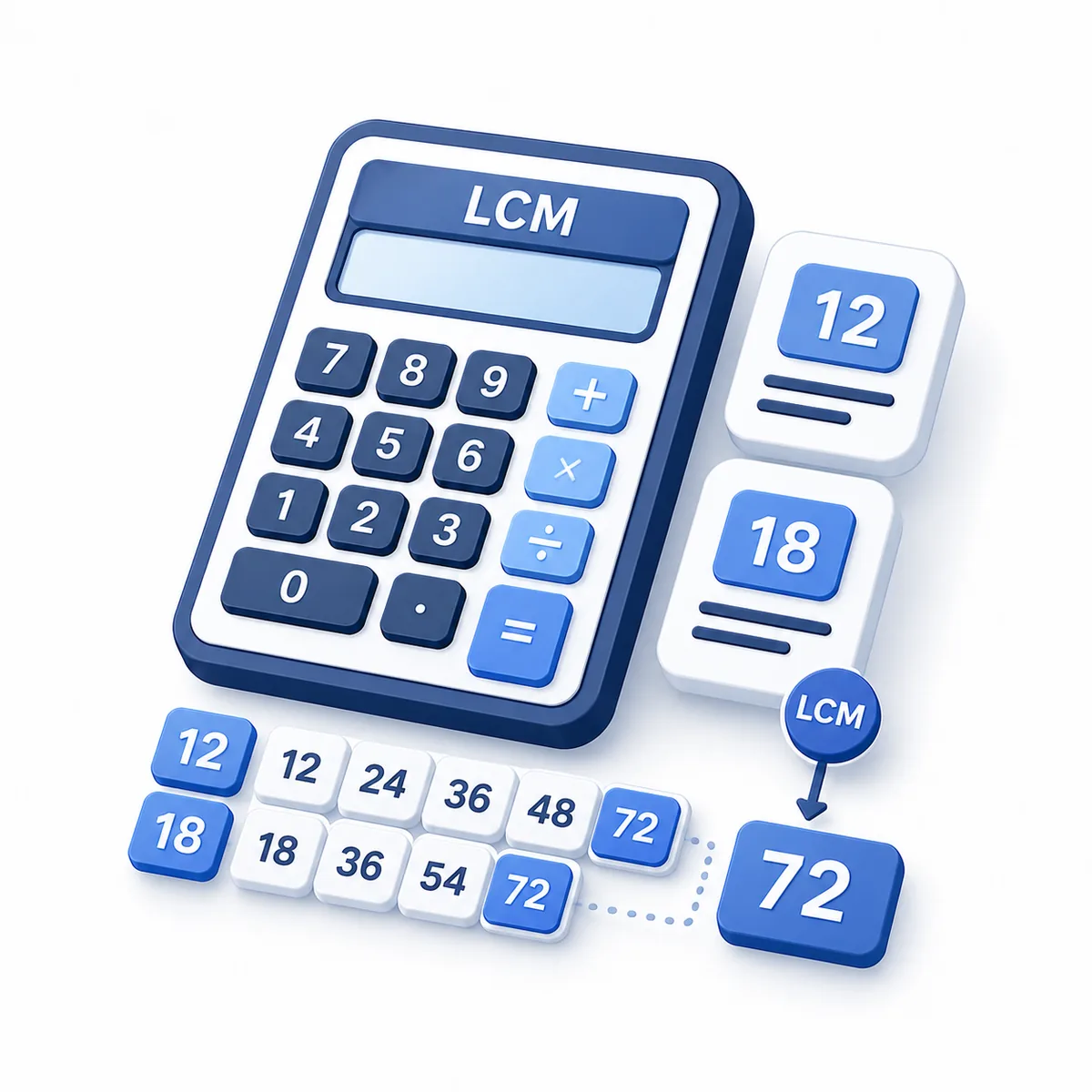
Compare prime factorization, ladder division, early multiples, and the pairwise GCD identity without changing the final LCM.
Choose a method that matches the problem
- 1Use early multiples for small numbers and a quick visual check.
- 2Use prime factors or ladder division when showing schoolwork.
- 3Use the pairwise GCD identity for an efficient calculation with larger values.
Prime-factor and pairwise-GCD methods should produce the same LCM.
Introduction
The LCM Calculator finds the least common multiple of two or more whole numbers and shows prime factors, highest prime powers, pairwise GCD work, early multiples, and least common denominator context.
What is LCM?
LCM means least common multiple. It is the smallest positive number that is divisible by every number in a given set, making it especially useful for fractions, repeating schedules, and number-pattern problems.
LCM method
The calculator shows prime factorization, ladder division, listing multiples, and the GCD/GCF formula applied pair by pair. Each method reaches the same least common multiple.
Variable explanations
Understand what each input and result means before calculating.
Numbers
The whole numbers used to find the LCM.
LCM
The smallest positive number divisible by every input value.
GCD
The greatest common divisor used in the pairwise formula.
LCD
The least common denominator, found by taking the LCM of fraction denominators.
Prime factors
Prime-number building blocks of each input value.
Highest prime powers
The largest exponent needed for each prime factor across all inputs.
Multiple
A number produced by multiplying another number by a whole number.
Reviewed by the Calculator.org.in Editorial Team
Formula behavior, validation cases, explanatory examples, and cited sources are checked before publication. This review supports educational accuracy and is not a substitute for qualified professional advice.
Last reviewed: 2026-08-25
Formula guide
See the calculation logic, variable definitions, and practical meaning.
Ladder or cake method
LCM = product of the prime divisors used in the ladder
- Divide any values divisible by the current prime and carry the others into the next row.
Continue until every value becomes 1, then multiply the divisors in the left column.
Two-number LCM
LCM(a,b) = abs(a x b) / GCD(a,b)
- GCD is the greatest common divisor.
Use this efficient method when the GCD is known.
Multiple numbers
LCM(a,b,c) = LCM(LCM(a,b), c)
- Apply the two-number formula repeatedly.
Use this for three or more whole numbers.
Prime factorization
LCM = product of highest prime powers
- Use each prime factor at its greatest exponent across all values.
Use this method when explaining LCM by factors.
Least common denominator
LCD = LCM of denominators
- Denominators are the bottom numbers in fractions.
Use LCM to add, subtract, or compare fractions with different denominators.
Common multiple check
LCM mod n = 0
- n is each input value.
The LCM must divide evenly by every entered number.
GCD and LCM relation
GCD(a,b) x LCM(a,b) = abs(a x b)
- This identity applies to two non-zero integers.
Use it to verify a two-number LCM.
Multiples list method
List multiples until the first common value appears
- The first shared positive multiple is the LCM.
This is easy for small numbers and helpful for learning.
Worked examples
Follow realistic inputs through the calculation step by step.
Worked example
LCM of 12 and 18
- 1GCD(12,18) = 6.
- 2LCM = (12 x 18) / 6 = 36.
- 336 is the smallest positive number divisible by both 12 and 18.
Worked example
LCM of 8 and 14
- 1GCD(8,14) = 2.
- 2LCM = (8 x 14) / 2 = 56.
Worked example
LCM of 12, 18, and 30
- 1LCM(12,18) = 36.
- 2LCM(36,30) = 180.
- 3The LCM of all three numbers is 180.
Worked example
Least common denominator
- 1For denominators 6 and 8, find LCM(6,8).
- 26 = 2 x 3 and 8 = 2^3, so use 2^3 x 3.
- 3The least common denominator is 24.
Common mistakes
Avoid these common input and interpretation errors.
Confusing LCM and GCD
LCM is a common multiple; GCD is a common divisor.
Using zero
This calculator requires non-zero whole numbers.
Dropping repeated prime factors
Prime factorization uses the highest exponent needed for each prime.
Stopping at any common multiple
The LCM is the least positive common multiple, not just any shared multiple.
Ignoring absolute values
Negative inputs are treated by their absolute values because LCM is reported positive.
Multiplying all numbers without checking overlap
The product is a common multiple, but it is often larger than the least common multiple.
Using LCM for decimals
This calculator is designed for whole numbers. Convert decimal contexts before using LCM.
Frequently asked questions
Quick answers to the questions users ask most often.
What does this LCM Calculator do?
What does LCM mean?
What is the LCM of 12 and 18?
What is the LCM of 8 and 14?
Can I enter more than two numbers?
Can I enter negative numbers?
Can I enter zero?
Can I enter decimals?
How is LCM different from GCD?
Why is LCM useful for fractions?
What is the prime factorization method?
What is the GCD formula for LCM?
What is the multiples list method?
What is the ladder or cake method?
Does order matter?
Can the LCM equal one of the numbers?
Is LCM always positive?
What is LCD?
How do I check an LCM answer?
Why is the product sometimes not the LCM?
Can this find GCD too?
References
Sources used to support the calculator guidance.
Related calculators
Continue with calculators that solve nearby problems.
Version history
A transparent record of calculator content updates.
- 1.2.0 · 2026-08-25
Added complete ladder-division working, a live LCM equation, and calculator-specific method guidance.
- 1.1.0 · 2026-08-03
Added GCD and LCD outputs, highest prime powers, pairwise GCD steps, multiples preview, table steps, and expanded fraction-denominator guidance.
- 1.0.0 · 2026-07-06
Initial LCM calculator release.