1. Network address
2001:db8:1234:5678::
The first address after all bits outside the prefix are cleared to zero.
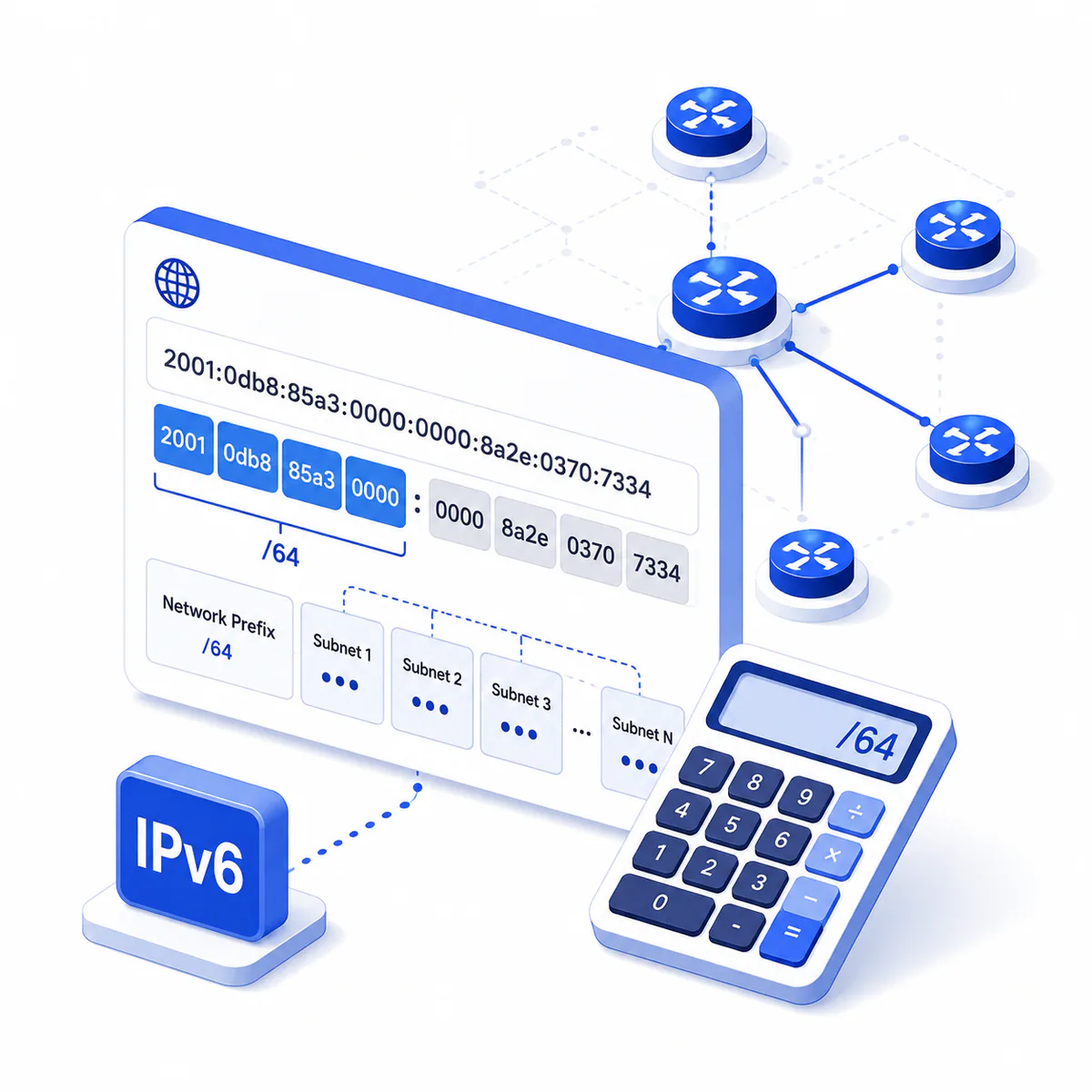
Find an IPv6 network address, understand its /prefix, and see the complete subnet range. Advanced mode adds child-prefix and reverse-DNS planning.
Compressed, expanded, IPv4-mapped, or CIDR notation; any embedded /prefix must match the field below.
For example, enter 64 for /64. This is the number of fixed network bits, from 0 to 128.
Start with the network and range, or include technical child-subnet and reverse-DNS planning.
Status: initial
Beginner result map
The address identifies one point. The prefix finds its network, and the network plus prefix determines the complete range.
2001:db8:1234:5678::
The first address after all bits outside the prefix are cleared to zero.
/64
64 network bits stay fixed; 64 remaining bits vary inside the subnet.
2001:db8:1234:5678:: → 2001:db8:1234:5678:ffff:ffff:ffff:ffff
These are mathematical boundaries. IPv6 does not reserve a broadcast address.
The IPv6 Subnet Calculator accepts compressed, expanded, IPv4-mapped, or matching CIDR notation and performs exact 128-bit calculations. Beginner mode leads with a plain-language network, /prefix, and complete range summary. Advanced mode adds expanded notation, reverse DNS, a selected child prefix, and allocation previews. IPv6 has no broadcast address, so the last address is reported only as a mathematical range boundary.
Use this tool when checking an ISP or cloud allocation, building an IP address management plan, studying subnetting, preparing reverse DNS, validating a route, or dividing a site prefix into smaller assignments. Treat the result as auditable address math, not as an automatic routing, SLAAC, DHCPv6, DNS, firewall, or security design.
An IPv6 address is expanded to 32 hexadecimal digits and stored as an exact BigInt. A prefix mask keeps the selected network bits and clears the remaining bits. Address and child-prefix counts are powers of two, while a child index is multiplied by the child block size to locate that allocation inside the parent.
Understand what each input and result means before calculating.
Enter eight hextets, use :: once to compress the longest zero run, or enter an IPv4-mapped tail. A zone identifier such as %eth0 is interface-local metadata and is intentionally rejected.
The slash length identifies how many leading bits belong to the routed network. Confirm it from the authoritative allocation source rather than inferring it from the address text.
A longer prefix divides the parent into equal blocks. Use hierarchy bits deliberately for region, site, zone, function, security boundary, or tenant while keeping route aggregation practical.
Index 0 selects the first child, index 1 the second, and so on. The field accepts a decimal string so allocations beyond 2^53 remain exact.
The preview shows the first few children for orientation. It does not enumerate huge allocations or replace an IPAM record of assigned, reserved, and available ranges.
The calculator identifies common special-purpose categories including unspecified, loopback, IPv4-mapped, multicast, link-local, unique local, documentation, and global unicast.
IPv6 reverse DNS uses nibble-reversed ip6.arpa names. A parent prefix divisible by four maps cleanly to a nibble boundary; other prefixes require a deliberate delegation method.
/64 is customary on SLAAC LANs because it provides a 64-bit interface identifier, but it is not a universal answer for every link. Point-to-point, loopback, and routed-prefix designs can use other lengths under applicable standards and platform rules.
Formula behavior, validation cases, explanatory examples, and cited sources are checked before publication. This review supports educational accuracy and is not a substitute for qualified professional advice.
Last reviewed: 2026-08-23
See the calculation logic, variable definitions, and practical meaning.
network = IPv6 address AND prefix mask
Clearing the interface bits produces the first address and canonical CIDR base for the parent prefix.
last = network + 2^(128 − N) − 1
IPv6 does not use IPv4 broadcast addressing, but a range still has a numerically highest address.
addresses = 2^(128 − N)
The exact decimal result is preserved even when it is far beyond JavaScript's safe integer range.
number of /64s = 2^(64 − N), when N ≤ 64
For a parent longer than /64, the calculator marks this count as not applicable rather than showing a fraction.
children = 2^(child prefix − parent prefix)
Each added subnet bit doubles the number of equal-size child prefixes.
child network = parent network + child index × 2^(128 − child prefix)
Using a decimal text index keeps very large selections exact.
reverse all 32 address nibbles and append .ip6.arpa
A full-address PTR owner uses every nibble; non-nibble-aligned prefix delegation needs additional DNS design.
Follow realistic inputs through the calculation step by step.
Worked example
Worked example
Worked example
Worked example
Worked example
Worked example
Worked example
Avoid these common input and interpretation errors.
IPv6 does not use broadcast. The highest value shown is only the last mathematical address in the prefix.
/64 is central to SLAAC and common LAN design, but point-to-point links, loopbacks, delegated prefixes, and other contexts can require different lengths.
A /48 or /56 is commonly divided into child prefixes. Assigning the entire parent to one segment can waste hierarchy and weaken aggregation.
IPv6 values exceed JavaScript's safe-number range. This calculator uses BigInt so counts, ranges, and child indices remain exact.
Each hexadecimal digit is four bits, while each hextet is 16 bits. Prefix boundaries do not always align with a full hextet.
Leading-zero suppression and :: compression change notation only. Expanded and canonical compressed forms represent the same 128-bit value.
Link-local, unique-local, multicast, documentation, loopback, and global-unicast addresses have different intended behavior and routing expectations.
Standard ip6.arpa labels are hexadecimal nibbles. A prefix that is not divisible by four needs an explicit DNS delegation approach.
For P parent bits and C child bits, valid zero-based indices run from 0 through 2^(C−P)−1.
Routing, RA, DHCPv6, DNS, firewall, monitoring, IPAM, platform behavior, and change controls must be reviewed together.
Quick answers to the questions users ask most often.
Sources used to support the calculator guidance.
Continue with calculators that solve nearby problems.
A transparent record of calculator content updates.
Added beginner and advanced result modes, a plain-language prefix summary, and a visual network-to-range guide.
Initial release with exact 128-bit range, notation, scope, reverse DNS, and child-prefix planning.