Lumber Calculator
Estimate whole lumber pieces, bundle rounding, nominal and actual board feet, linear length, cubic volume, weight, fasteners, delivery loads, and cost in metric or imperial units.
- lumber takeoff
- wood quantity
- timber quantity
- lumber pieces
- lumber bundles
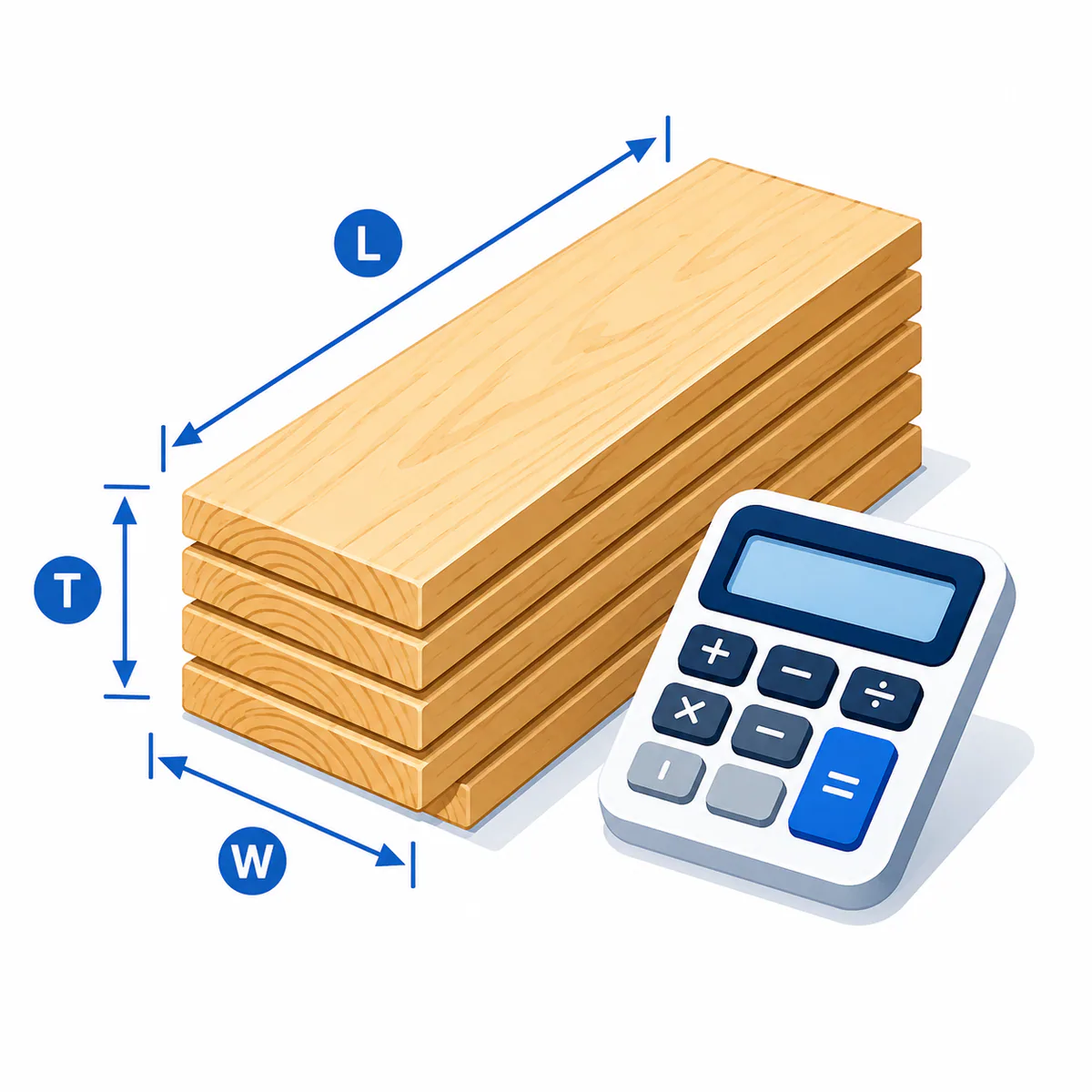
Inches in imperial mode or millimetres in metric mode.
The trade or quoted width before surfacing.
Measured dressed thickness; 1.5 in is common for a nominal 2 in board.
Measured dressed width; 3.5 in is common for a nominal 4 in board.
Feet in imperial mode or metres in metric mode.
The usable whole-piece requirement before waste and purchase rounding.
Extra stock for cuts, defects, grain selection, damage, and site loss.
Enter 1 when pieces can be bought individually.
Used only when Custom density is selected.
Adds weight for wetter-than-reference stock without changing volume.
Uses feet in imperial mode and metres in metric mode.
Enter 0 to skip the delivery-load estimate.
Status: initial
Results
Awaiting calculation
See why required pieces and purchased lumber are not the same
The result separates clean pieces, waste rounding, supplier bundles, nominal tally, actual wood volume, quote basis, and transport weight.
- Clean pieces20
- After waste22
- Purchased pieces25
- Actual board feet87.5
What fills the purchased bundle
- Clean cut list
- 20
- Waste and whole-piece reserve
- 2
- Bundle rounding surplus
- 3
Turn the estimate into a verified lumber order
- 1Optimize the cut list by stock length, then calculate every section, species, grade, treatment, and length as a separate line item.
- 2Ask the supplier whether the tally uses nominal, rough, or measured dimensions and whether bundles can be split.
- 3Confirm moisture, defects, usable length, taxes, returns, fasteners, pack weight, vehicle capacity, load securing, delivery access, and structural documentation.
Board feet can describe a supplier tally while actual dimensions describe the physical wood received. Keeping both visible prevents a low unit rate or familiar size name from hiding a different quantity.
A lumber takeoff that follows the way wood is actually purchased
The Lumber Calculator starts with the clean number of full-length pieces your cut list requires, adds waste, rounds to whole stock pieces and supplier bundles, and then converts the purchase into linear length, nominal board feet, actual board feet, CFT, cubic metres, weight, fasteners, delivery loads, and comparable costs. It is deliberately broader than a basic board-foot calculator.
When to use this calculator
Use it to prepare a quote request for framing lumber, dimensional softwood, hardwood boards, decking stock, battens, rails, or general timber sold by piece, linear length, board foot, or cubic foot. Calculate every size, length, species, grade, and treatment as a separate line item. Structural member selection, spans, connections, fire performance, durability, and code compliance require qualified design and product documentation.
How clean pieces become a purchase quantity
The calculator applies the waste percentage to the clean piece count, rounds up to whole pieces, and then rounds again to the entered supplier bundle size. Board feet use thickness in inches, width in inches, and length in feet. Nominal dimensions represent the trade section; actual dimensions represent physical wood received. Weight uses actual cubic metres, a selected density, and an optional moisture sensitivity.
Variable explanations
Understand what each input and result means before calculating.
📐 Nominal dimensions
The named or trade section used in a quote, such as 2 × 4. It may describe rough stock or a standardized pre-surfacing size rather than the wood you can measure.
📏 Actual dimensions
The finished thickness and width after drying and surfacing. Measure the product or use the supplier's published dressed size; do not assume every market follows North American dimensional-lumber conventions.
↔️ Stock length
The full piece available for purchase. A cut list based on shorter components needs a cutting layout before it can be converted into full stock pieces.
🪚 Clean pieces
The number of full stock pieces required before allowance. If one stock piece produces several parts, optimize the cutting pattern first and enter the resulting stock-piece count.
➕ Waste and selection
Straight framing with consistent stock may need a modest allowance; rough hardwood, appearance selection, complex cuts, end checks, knots, warp, and low offcut reuse may require more.
📦 Bundle size
Commercial rounding can exceed calculated waste. Enter 1 for loose pieces or the exact merchant pack quantity when the supplier will not split bundles.
🌲 Density
The presets are broad reference values in kilograms per cubic metre. Species alone does not fix density; moisture, growth, grade, and product manufacture matter.
💧 Moisture weight sensitivity
Use this to test a heavier delivery condition. It is not the same as moisture content by oven-dry mass and should not be used to certify kiln-dried stock.
🧾 Board-foot billing basis
Choose nominal only when the quote is based on nominal or rough tally. Choose actual when the supplier bills measured finished dimensions. Ask before comparing rates.
₹ Quote rates
Enter as many current rates as you have. A zero rate is treated as not quoted. The comparison adds the same entered fastener and delivery extras to every active material basis.
🔩 Fasteners
This is a count-and-box rounding aid. Fastener type, diameter, length, coating, spacing, edge distance, withdrawal, shear, corrosion, and connector schedule need project-specific design.
🚚 Vehicle payload
Payload loads are calculated from moisture-sensitive wood weight. Volume, deck length, stacking, axle limits, securing, access, and legal road limits may control before mass does.
Reviewed by the Calculator.org.in Editorial Team
Formula behavior, validation cases, explanatory examples, and cited sources are checked before publication. This review supports educational accuracy and is not a substitute for qualified professional advice.
Last reviewed: 2026-08-09
Formula guide
See the calculation logic, variable definitions, and practical meaning.
Board feet per piece
thickness (in) × width (in) × length (ft) ÷ 12
- Use nominal or rough dimensions when that is the supplier's tally rule
- Use actual measured dimensions for physical volume or an actual-dimension quote
- One board foot is a volume of 144 cubic inches
The calculator shows nominal and actual board feet side by side because market conventions differ by material and supplier.
Waste-adjusted whole pieces
ceiling[clean pieces × (1 + waste percentage)]
- Clean pieces are the usable cut-list requirement
- Waste covers cutting, defects, grain selection, damage, and unusable ends
- The result rounds upward because a fraction of a stock piece cannot be purchased
A percentage applied to pieces is most reliable when every entered piece has the same stock length and section.
Supplier bundle purchase
ceiling(waste-adjusted pieces ÷ pieces per bundle) × pieces per bundle
- Enter 1 when the merchant sells individual pieces
- Enter the actual strapped pack or bundle quantity when whole bundles are mandatory
- Bundle surplus is kept separate from the waste-adjusted requirement
This second rounding step prevents a correct material estimate from understating the commercial order.
Actual cubic volume
actual thickness × actual width × stock length × purchased pieces
- All dimensions are converted internally to metres
- CFT is cubic feet and m³ is cubic metres
- Actual volume is used for weight and the CFT quote comparison
Physical volume can be lower than a nominal softwood tally because planing reduces thickness and width.
Weight sensitivity
actual m³ × reference density × (1 + moisture weight sensitivity)
- Density varies with species, grade, growth, and moisture condition
- The moisture percentage changes weight, not geometric volume
- Supplier weight or a weighbridge value should replace the estimate for transport decisions
This is a payload planning check, not a moisture-content calculation or structural property.
Delivered quote comparison
material on one quote basis + whole fastener boxes + payload-based delivery loads
- Per-piece and linear quotes use the bundle-rounded purchase quantity
- Board-foot quotes use the selected nominal or actual basis
- CFT quotes use actual entered dimensions
Only compare totals whose rates describe the same species, grade, treatment, moisture, length, service, and tax basis.
Worked examples
Follow realistic inputs through the calculation step by step.
Worked example
Order nominal 2 × 4 framing stock
- 1Choose imperial and enter nominal 2 × 4, actual 1.5 × 3.5, and the available stock length.
- 2Enter the full-length clean-piece requirement, framing waste, and the supplier's pack size.
- 3Use nominal board feet only if that matches the quotation and review actual weight for delivery.
Worked example
Compare loose pieces with a whole bundle
- 1Run the estimate with one piece per bundle to see the exact whole-piece order.
- 2Replace bundle size with the supplier's strapped-pack quantity.
- 3Compare the bundle rounding surplus with expected future use, storage, and return policy.
Worked example
Price hardwood by board foot
- 1Enter the supplier's rough thickness, measured average width, stock length, and actual billing basis.
- 2Increase waste for defects, sapwood limits, matching, milling, and grain selection where appropriate.
- 3Confirm whether widths and lengths are tallied individually rather than as one average board.
Worked example
Check an Indian CFT timber quote
- 1Use metric millimetres and metres or imperial inches and feet to match the merchant's tally sheet.
- 2Enter measured finished dimensions and the quoted INR per cubic foot.
- 3Compare actual CFT cost with per-piece quotes only when grade, seasoning, tax, and delivery are equivalent.
Worked example
Estimate a small delivery payload
- 1Select the nearest species density or enter supplier density.
- 2Add a realistic moisture weight sensitivity and vehicle payload.
- 3Have the supplier confirm actual pack weight, stacking footprint, securing, axle loading, and delivery access.
Worked example
Prepare a multi-size framing takeoff
- 1Separate studs, plates, headers, blocking, battens, and treated sill stock by section and length.
- 2Run the calculator once for every distinct line item and record each purchase result.
- 3Do not combine board feet across sizes until bundle rules, grades, and unit prices have been checked separately.
Common mistakes
Avoid these common input and interpretation errors.
Treating board feet as linear feet
Board feet measure volume; linear feet measure length. Two boards with equal length but different sections have equal linear feet and different board feet.
Using actual dimensions for every supplier tally
Some dimensional softwood and rough-lumber markets bill nominal or rough sizes. Confirm the contract basis before applying a rate.
Using nominal dimensions for weight
Transport weight depends on physical wood volume, so this calculator uses actual dimensions for cubic volume and density.
Applying waste to board feet but not pieces
A volume allowance can still leave too few full-length members. This calculator applies waste to whole stock pieces before bundle rounding.
Ignoring cutting optimization
Several short parts may share one long board. Convert the part list to full stock pieces with a cutting layout before entering clean pieces.
Assuming offcuts are always reusable
Reuse depends on required lengths, grade, end condition, defects, grain direction, and future work. Do not automatically subtract every offcut from waste.
Forgetting supplier bundles
A merchant may quote a minimum pack even when the calculated order needs fewer pieces. Bundle rounding exposes the resulting surplus and cost.
Comparing unlike quote rates
A low per-piece rate may cover a different length, section, species, grade, treatment, seasoning, tax, or delivery service. Normalize the product first.
Using one density as an exact shipping weight
Wood density varies substantially. Use supplier pack weight or a weighbridge for legal payload and lifting decisions.
Confusing moisture sensitivity with moisture content
The entered percentage is only a weight multiplier. It does not calculate oven-dry moisture content or certify a timber condition.
Sizing structural members from quantity alone
A takeoff cannot validate strength, stiffness, span, load path, bracing, connections, fire, durability, or code compliance.
Ignoring storage and acclimation
Bundle surplus and early delivery require dry, supported, ventilated storage and product-specific acclimation or moisture checks.
Frequently asked questions
Quick answers to the questions users ask most often.
How do I calculate how much lumber I need?
What is the formula for board feet?
Is a board foot the same as a linear foot?
Should board feet use nominal or actual dimensions?
Why is a nominal 2 × 4 not actually 2 inches by 4 inches?
How many board feet are in one cubic foot?
What does CFT mean in a timber quote?
How much waste should I add for lumber?
Why does the calculator round waste to whole pieces?
What should I enter for bundle size?
How does the lumber weight estimate work?
Can I use this to calculate green lumber weight?
How are delivery loads calculated?
Does the cheapest quote comparison include waste and bundles?
Can I calculate several lumber sizes together?
Can this calculator design framing or choose lumber size?
References
Sources used to support the calculator guidance.
- HeLovesMath — Lumber Board Foot Calculator
- BuildVision AI — Board Foot Calculator
- CalcShed — Lumber Calculator
- TakeoffCalc — Board Foot Calculator
- Turn2Engineering — Lumber Calculator
- Board-Foot-Calculator.org — Board Foot Calculator
- EstimationPro — Lumber Calculator
- Lumber Minneapolis — Size Guide Calculator
- CalcSummit — Lumber Calculator
- Tallyard — Lumber Calculator
Related calculators
Continue with calculators that solve nearby problems.
- Board Feet Calculator
- Cubic Feet Calculator
- Volume Calculator
- Flooring Calculator
- Stair Calculator
- Roof Pitch Calculator
Version history
A transparent record of calculator content updates.
- 1.0.0 · 2026-08-09
Initial independent release based on a ten-result search benchmark, with metric and imperial sections, clean-piece waste, bundle rounding, nominal versus actual board feet, CFT, cubic metres, linear length, species density, moisture-sensitive weight, fasteners, delivery payloads, and four rupee quote bases.