Concrete Calculator
Estimate concrete cubic feet, cubic yards, waste allowance, bag count, and optional cost with a clearly labeled design-strength reference for rectangular or round pours.
- concrete yards
- concrete bags
- slab concrete
- footing concrete
- ready mix
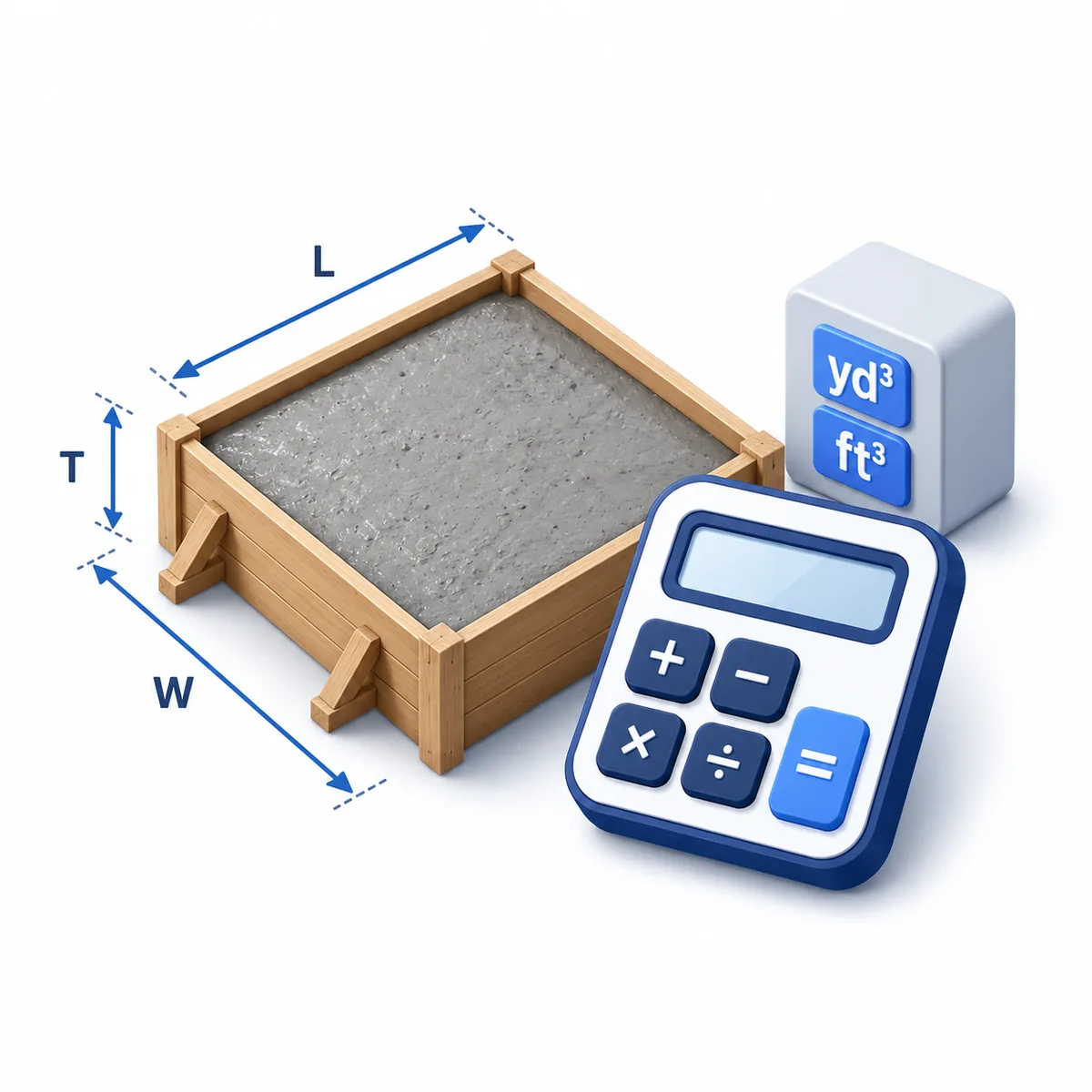
Choose the shape that best matches the pour.
For rectangular pours, enter length in feet.
For rectangular pours, enter width in feet.
Enter slab thickness, footing depth, or post-hole depth in inches.
Optional number of identical pours.
Advanced optionsOptional issuer and comparison assumptions
Optional extra percentage for overage, spillage, and uneven subgrade.
Optional ordering reference only. It does not change volume or create a concrete mix design.
Choose a common pre-mix bag size for bag estimates.
Optional ready-mix price for a rough cost estimate.
Optional bag price for a rough bagged-concrete cost estimate.
Status: initial
Results
Awaiting calculation
3.25 yd³ ready-mix order
The rectangular pour needs 2.8 cubic yards before allowance and 3.1 cubic yards after waste, equivalent to about 140 selected premix bags.
Use this result well
- 1Choose rectangular or round geometry and measure every finished dimension consistently.
- 2Compare ready-mix rounding with the selected premix bag yield and project access.
- 3Confirm strength, reinforcement, subgrade, waste, and supplier minimums before ordering.
Volume does not determine concrete strength, reinforcement, thickness, or structural suitability.
Introduction
The Concrete Calculator estimates concrete volume for rectangular slabs, pads, footings, and round post holes or columns from project dimensions.
What is a concrete calculator?
A concrete calculator converts project dimensions into cubic feet, cubic yards, bag estimates, rounded ready-mix ordering guidance, and optional ready-mix or bagged-concrete cost so users can plan before ordering materials.
Concrete formula
For a rectangular pour, multiply length by width by thickness in feet. For a round pour, use pi times radius squared times depth. Divide cubic feet by 27 to convert to cubic yards, then add waste allowance.
Variable explanations
Understand what each input and result means before calculating.
Project shape
Choose rectangular for slabs, pads, walls, and footings, or round for columns and post holes.
Length
The long side of the rectangular slab, pad, or footing.
Width
The short side or cross-section width.
Diameter
The width across a round post hole, pier, or column.
Thickness or depth
The slab thickness, footing depth, or post-hole depth in inches.
Waste
Extra allowance for subgrade, forms, spillage, and ordering margin.
Bag size
A common pre-mix bag size used for the main bag estimate.
Price per bag
Optional price used for a rough bagged-concrete cost estimate.
Reviewed by the Calculator.org.in Editorial Team
Formula behavior, validation cases, explanatory examples, and cited sources are checked before publication. This review supports educational accuracy and is not a substitute for qualified professional advice.
Last reviewed: 2026-08-25
Formula guide
See the calculation logic, variable definitions, and practical meaning.
Cubic feet
Cubic Feet = Length(ft) x Width(ft) x Thickness(ft)
- Thickness in inches is divided by 12 first.
This estimates the volume of one rectangular pour.
Cubic yards
Cubic Yards = Cubic Feet / 27
- One cubic yard equals 27 cubic feet.
Ready-mix concrete is commonly estimated in cubic yards.
Round post hole or column
Cubic Feet = pi x (Diameter(ft) / 2)^2 x Depth(ft)
- Diameter and depth are converted to feet before calculation.
This estimates cylindrical concrete volume for piers, columns, or post holes.
Bag estimate
Bags = Cubic Feet with Waste / Bag Yield
- Bag yields are approximate and depend on product and mixing.
Use this only as a planning estimate for bagged concrete.
Ready-mix order rounding
Suggested Order = cubic yards with waste rounded up to nearest 0.25 yd^3
- Supplier rounding and minimum order rules can vary.
Rounding up provides a practical ordering number instead of only the exact calculated volume.
Worked examples
Follow realistic inputs through the calculation step by step.
Worked example
Small slab
- 1Length is 10 ft.
- 2Width is 10 ft.
- 3Thickness is 4 in.
- 4Volume is 1.23 cubic yards before waste.
Worked example
Waste allowance
- 1Base volume is 1.23 cubic yards.
- 2Waste is 10%.
- 3Plan for about 1.36 cubic yards.
Worked example
Bagged concrete
- 1Choose a bag size.
- 2Divide cubic feet with waste by approximate bag yield.
- 3Round up to whole bags.
Worked example
Round post hole
- 1Choose round column, pier, or post hole.
- 2Enter the hole diameter and depth in inches.
- 3Enter the number of identical holes.
- 4Review the bag breakdown for 40 lb, 60 lb, and 80 lb bags.
Worked example
Ready-mix ordering
- 1Enter the price per cubic yard if known.
- 2Review cubic yards with waste.
- 3Use the rounded order suggestion as a practical discussion point with the supplier.
Common mistakes
Avoid these common input and interpretation errors.
Forgetting thickness conversion
Thickness in inches must be divided by 12 before multiplying by feet.
Ordering exact volume
Concrete projects often need extra allowance for variation and waste.
Using bag estimates as exact yields
Bag yield varies by product, water, mixing, and placement.
Ignoring supplier minimums
Ready-mix suppliers may have minimum order or short-load fees.
Using rectangular dimensions for a round hole
Post holes and columns use a cylinder formula, not length times width.
Forgetting to round up bags
Bagged concrete should be rounded up to whole bags, and an extra bag may prevent a short pour.
Frequently asked questions
Quick answers to the questions users ask most often.
What does this Concrete Calculator calculate?
How do you calculate concrete for a slab?
How many cubic feet are in a cubic yard?
Why is thickness entered in inches?
What waste allowance should I use?
Does this calculate post holes?
Does this calculate circular columns?
How are concrete bags estimated?
Are bag yields exact?
How many 80 lb bags are in a cubic yard?
Why does the calculator show all bag sizes?
Why round ready-mix to a quarter yard?
Can I estimate ready-mix cost?
Does this include delivery fees?
Can I use this for footings?
Can I use this for stairs?
Should I order exactly the calculated amount?
Is this construction advice?
References
Sources used to support the calculator guidance.
Related calculators
Continue with calculators that solve nearby problems.
Version history
A transparent record of calculator content updates.
- 1.2.0 · 2026-08-25
Added shape-aware dimensions, focused advanced options, and a live ready-mix versus bag summary.
- 1.0.0 · 2026-07-05
Initial concrete slab and footing calculator release.
- 1.1.0 · 2026-08-02
Added round post-hole and column mode, all-size bag breakdown, ready-mix order rounding, bag cost estimates, and ordering guidance.