Long Division Calculator
Divide whole numbers with quotient, remainder, decimal result, and long division steps.
- long division
- quotient remainder
- division steps
- divide whole numbers
- remainder calculator
The number being divided.
The number to divide by. It cannot be zero.
How many decimal places to show for the decimal result.
Status: initial
Results
Awaiting calculation
Quotient and remainder
Read the answer in the traditional bracket, then follow each divide, multiply, subtract, and bring-down operation.
845 / 6 = 140 R 5
Multiply the divisor by the quotient and add the remainder to verify the result.
Introduction
The Long Division Calculator divides whole numbers and shows a school-style division bracket, quotient, remainder, decimal result, simplified fraction form, repeating decimal notation, check equation, and every divide, multiply, subtract, and bring-down step.
What is long division?
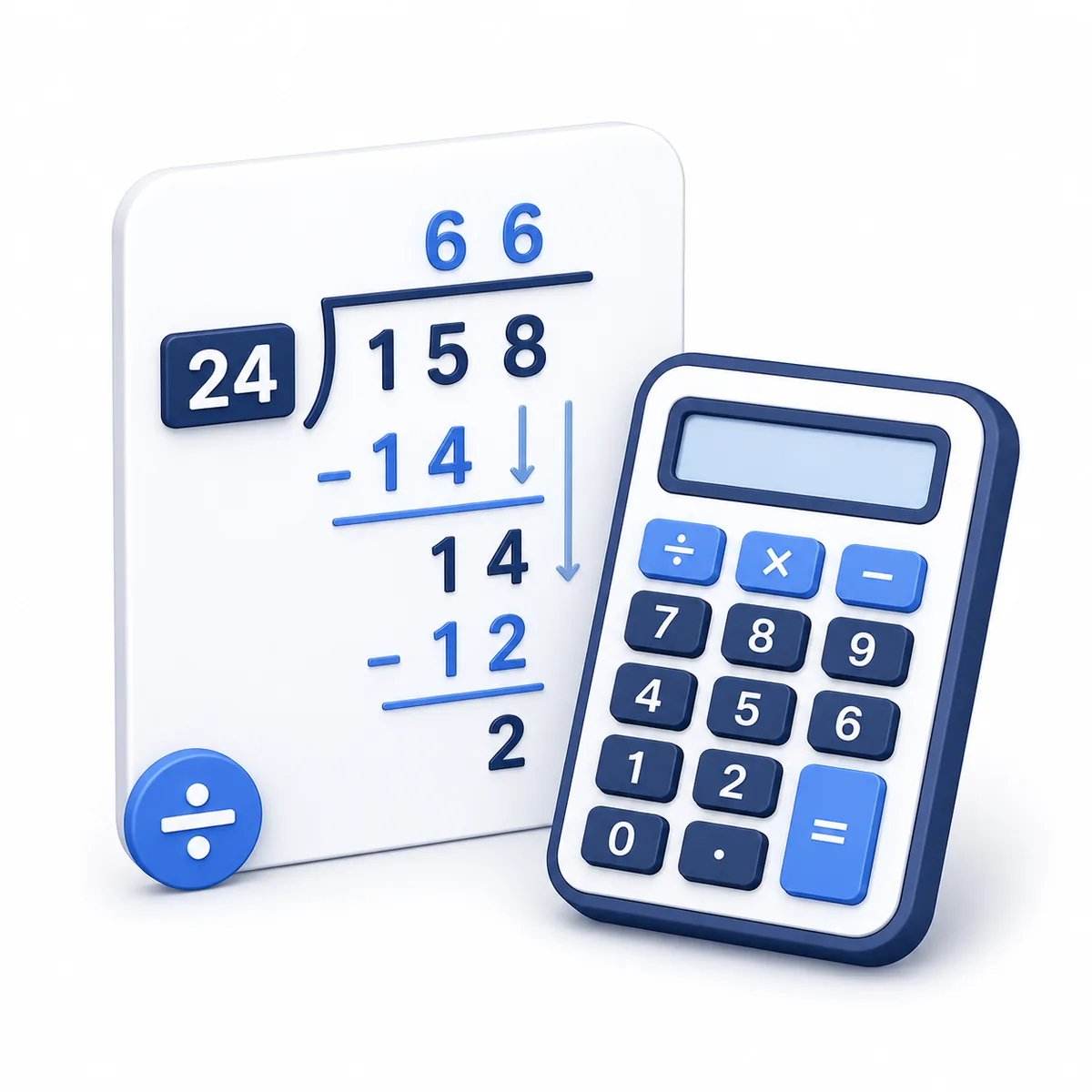
Long division is a written method for dividing a dividend by a divisor. The calculator lays out the dividend under the bracket, the divisor outside it, and the quotient above it, then breaks the work into repeatable divide, multiply, subtract, and bring-down steps.
Long division method
At each step, bring down the next digit, divide the partial dividend by the divisor, multiply back, subtract, and carry the remainder forward. If there is a remainder, the calculator can continue into decimal places by adding zeros after the decimal point.
Variable explanations
Understand what each input and result means before calculating.
Dividend
The number being divided.
Divisor
The number you divide by. It cannot be zero.
Quotient
The whole-number result of division.
Remainder
The amount left over after whole-number division.
Partial dividend
The current number being divided in a long division step.
Product
The quotient digit multiplied by the divisor.
Decimal digit
The digit found by continuing division after the decimal point.
Check equation
The multiplication statement used to verify the answer.
Reviewed by the Calculator.org.in Editorial Team
Formula behavior, validation cases, explanatory examples, and cited sources are checked before publication. This review supports educational accuracy and is not a substitute for qualified professional advice.
Last reviewed: 2026-08-25
Formula guide
See the calculation logic, variable definitions, and practical meaning.
Remainder form
Dividend = divisor x quotient + remainder
- The remainder must be less than the divisor.
Use this to check any quotient and remainder answer.
Decimal form
Decimal result = dividend / divisor
- Decimal places control displayed precision.
Use this when you need an approximate decimal quotient.
Mixed-number form
Dividend / divisor = quotient + remainder / divisor
- The fraction part can be simplified by the greatest common divisor.
Use this when a remainder answer should also be shown as a fraction.
Long division cycle
Divide, multiply, subtract, bring down
- Each digit of the dividend is processed from left to right.
This is the school-style workflow shown in the step table.
Decimal continuation
New partial dividend = remainder x 10
- A zero is brought down after the decimal point.
Repeat this to generate decimal digits after the whole-number quotient.
Terminating decimal check
A simplified denominator with only factors 2 and 5 terminates
- The denominator is the divisor after simplifying the remainder fraction.
Other denominators create repeating decimals.
Remainder rule
0 <= remainder < divisor
- The divisor must be positive.
If the remainder is equal to or greater than the divisor, the quotient is too small.
Worked examples
Follow realistic inputs through the calculation step by step.
Worked example
845 divided by 6
- 1845 / 6 = 140 R 5.
- 2The decimal is 140.8(3), meaning the 3 repeats.
- 3Check: 6 x 140 + 5 = 845.
Worked example
100 divided by 7
- 1100 / 7 = 14 R 2.
- 2The decimal repeats as 14.(285714).
- 3The remainder fraction is 14 2/7.
Worked example
Even division
- 1144 / 12 = 12 R 0.
- 2The decimal terminates at 12.
- 3The simplified fraction result is 12.
Worked example
Simplified remainder fraction
- 118 / 12 = 1 R 6.
- 2The remainder fraction 6/12 simplifies to 1/2.
- 3The mixed-number result is 1 1/2.
Worked example
Zero in the quotient
- 11,005 / 5 starts with 10 / 5 = 2.
- 2Bring down 0; write 0 in the quotient because 5 goes into 0 zero times.
- 3Bring down 5 to finish with 201 R 0.
Common mistakes
Avoid these common input and interpretation errors.
Dividing by zero
A divisor cannot be zero because division by zero is undefined.
Forgetting zero quotient digits
Some steps need a 0 digit in the quotient when the partial dividend is smaller than the divisor.
Confusing dividend and divisor
In dividend / divisor, the dividend is the number being divided and the divisor is the number dividing it.
Leaving a large remainder
The remainder should always be smaller than the divisor.
Stopping before the decimal point
If you need a decimal answer, continue by bringing down zeros after the decimal point.
Treating a repeating decimal as exact
A rounded decimal such as 0.3333 is approximate; 0.(3) or 1/3 is exact.
Skipping the check equation
Always verify with divisor x quotient + remainder = dividend.
Frequently asked questions
Quick answers to the questions users ask most often.
What does this Long Division Calculator do?
What is the dividend?
What is the divisor?
What is the quotient?
What is the remainder?
Can the divisor be zero?
Can I use decimals as inputs?
What is the long division cycle?
How do I check a remainder answer?
Should the remainder be smaller than the divisor?
What does 845 divided by 6 equal?
Can this show decimal places?
What does repeating decimal notation mean?
Why are some quotient digits zero?
What is a partial dividend?
What is decimal continuation?
When does a decimal terminate?
When does a decimal repeat?
How do I simplify the remainder fraction?
Is long division still useful?
Does this handle polynomial long division?
Does the calculator show the traditional long division bracket?
References
Sources used to support the calculator guidance.
Related calculators
Continue with calculators that solve nearby problems.
Version history
A transparent record of calculator content updates.
- 1.2.0 · 2026-08-25
Added a school-style division bracket, explicit DMSB expressions for every digit, and refreshed search metadata for step-by-step remainder intent.
- 1.1.0 · 2026-08-03
Added simplified fraction result, check equation, repeating decimal notation, decimal continuation steps, place value summary, and expanded long-division guidance.
- 1.0.0 · 2026-07-06
Initial long division calculator release.